France Moyenorient - Ideas & Analysis

Rigorous political analysis for readers who want to understand the system, not just react to it.

The Hidden Economics of Ballot Access: How Money Shapes Who Gets to Run

The Price Tag of Democracy

When we talk about voting rights in America, we usually focus on who gets to cast a ballot. But there’s an equally important question that gets far less attention: who gets to appear on that ballot in the first place. The mechanics of ballot access reveal a complex web of financial barriers, administrative hurdles, and institutional gatekeeping that shapes the range of choices available to voters. These barriers aren’t accidents of bureaucratic inefficiency. They’re the product of deliberate policy choices that reflect competing economic and political interests.

The costs of getting on a ballot vary dramatically across states, creating what amounts to a patchwork system of democratic participation. In some states, a candidate for governor might need to collect 1,000 signatures and pay a modest filing fee. In others, the requirement might be 50,000 signatures or a fee of several thousand dollars. These differences aren’t merely technical details. They represent completely different philosophies about who should have access to the democratic process and what role money should play in determining that access.

Understanding ballot access requires recognizing that every signature requirement, every filing fee, and every administrative deadline creates both intended and unintended consequences. The stated goals are often reasonable: preventing frivolous candidacies, ensuring serious commitment, and managing the practical logistics of elections. But these same mechanisms inevitably favor candidates with existing financial resources, professional networks, and institutional support. The challenge is distinguishing between legitimate administrative needs and barriers that protect incumbents or established parties from competition.

The Signature Economy

Signature collection has evolved into a specialized industry that reveals much about how money flows through the electoral process. Professional petition circulators can command wages of $15 to $30 per hour in competitive markets, and experienced operations can collect signatures for $3 to $8 each, depending on the jurisdiction and difficulty of the petition drive. For a candidate facing a 10,000-signature requirement with a validity rate of 60 percent, the professional cost might range from $50,000 to $130,000. That’s before accounting for management, legal review, and contingency planning.

This economic reality creates a clear advantage for candidates who can either afford professional services or mobilize extensive volunteer networks. Wealthy candidates can simply purchase their way onto the ballot. Those backed by established organizations can leverage existing membership and activist networks. Independent or insurgent candidates often face the most difficult path, lacking both financial resources and organizational infrastructure. The signature process functions as an informal primary election where money and institutional support matter more than voter preference.

The signature economy also creates perverse incentives for how campaigns allocate resources. A candidate might spend 20 to 30 percent of their total campaign budget simply getting on the ballot, money that could otherwise go toward voter outreach or policy development. This front-loaded financial burden particularly hurts candidates who might build support over time through grassroots organizing or media attention. The system requires candidates to demonstrate financial viability before they can demonstrate electoral viability.

Filing Fees and Economic Gatekeeping

Filing fees represent perhaps the most straightforward form of economic gatekeeping in American elections. States like California charge $3,480 for a U.S. House race and $6,960 for Senate, while Texas requires $5,000 for statewide offices. These fees are justified as covering administrative costs, but the numbers rarely bear close scrutiny. The actual cost of printing a candidate’s name on a ballot and processing basic paperwork runs in the dozens of dollars, not thousands. The gap between stated administrative costs and actual fees reveals the true purpose: creating a financial threshold that limits the candidate pool.

The economic impact extends beyond the immediate fee structure. Candidates who cannot afford filing fees often have the option to collect additional signatures in lieu of payment, but this alternative typically requires significantly more signatures than the standard ballot access petition. In Texas, for example, candidates can avoid the filing fee by collecting signatures equal to two percent of the vote total in the last similar election. That often means tens of thousands of additional signatures. This “fee or signatures” choice forces candidates to choose between immediate financial burden and extended organizational demands.

Perhaps more telling is how filing fees interact with campaign finance systems. Candidates who can raise sufficient funds to pay filing fees early in the campaign cycle signal credibility to potential donors and endorsers. Those who struggle to meet these initial thresholds often find it harder to raise subsequent funds, creating a spiral where early financial disadvantage becomes self-reinforcing. The filing fee system functions as an informal screening mechanism that sorts candidates by economic viability rather than electoral merit.

The Institutional Players

Major political parties benefit significantly from ballot access barriers, though they rarely acknowledge this advantage explicitly. Established parties typically have automatic ballot lines or significantly reduced requirements for their nominees, while third parties and independents face the full burden of signature collection and filing fees. This asymmetry isn’t accidental. It reflects decades of legislative decisions that favor the existing two-party duopoly. The parties that write election laws naturally write them in ways that protect their own interests.

Professional campaign services represent another key institutional player in the ballot access ecosystem. Law firms specializing in election law, petition circulation companies, and political consulting firms all have economic incentives to maintain complex ballot access requirements. Simpler, cheaper ballot access would reduce demand for their services, while complex requirements ensure steady business. This creates a subtle but persistent lobbying pressure against reform, as the professionals who understand the system best benefit from its complexity.

Election administrators occupy a more complicated position. County clerks, secretaries of state, and election boards must balance legitimate administrative concerns against democratic access. Many are genuinely committed to fair elections, but they also face practical constraints: limited budgets, tight timelines, and legal liability for errors. Complex ballot access requirements provide legal cover and administrative predictability, even when they create democratic barriers. The incentive structure pushes administrators toward more restrictive rather than more inclusive interpretations of ballot access rules.

Reform Pathways and Their Complications

The most obvious reforms face predictable political obstacles. Lower fees, fewer signatures, simpler procedures? Incumbent legislators have little incentive to make it easier for challengers to appear on their ballots. Established parties resist changes that would increase competition. Professional service providers oppose reforms that would reduce demand for their expertise. Even well-intentioned administrators worry about unintended consequences of loosening ballot access requirements.

More promising reform approaches focus on evening the playing field rather than simply lowering barriers. Public financing systems can help cover ballot access costs for qualifying candidates. Standardized petition formats and digital collection systems can reduce the advantage of professional operations. Clear deadlines and streamlined verification processes can reduce administrative discretion and uncertainty. These approaches acknowledge legitimate concerns about ballot management while addressing economic inequities in the current system.

The challenge for reformers is building coalitions that can overcome entrenched interests while avoiding unintended consequences. Ballot access reform requires strange political bedfellows: civil liberties advocates concerned about democratic participation, fiscal conservatives worried about government barriers to competition, and third-party activists seeking greater electoral choice. Success depends on finding common ground among these groups while addressing legitimate concerns about election administration and ballot management. The economics of ballot access will continue shaping American democracy until we decide whether we want our elections determined by money or by votes.


The Measurement Problem: Why Government Transparency Rankings Tell Only Half the Story

The Seductive Appeal of Transparency Metrics

Every year, organizations like Transparency International, the World Justice Project, and the Sunshine Foundation release rankings that claim to measure government transparency across countries. These lists grab headlines, drive policy debates, and shape what people think about how accountable their institutions really are. Finland always tops the charts, while countries like Somalia and North Korea sink to the bottom. The United States usually ends up somewhere in the middle, which both frustrates transparency advocates and surprises international observers who expect more from the world’s oldest constitutional democracy.

The Measurement Problem: Why Government Transparency Rankings Tell Only Half the Story

The problem with these rankings goes way beyond obvious flaws in methodology or sample size. The real issue is what scholars call “the measurement problem” in political science: the gap between what we want to measure and what we can actually count. Transparency covers everything from freedom of information laws to public meeting requirements, from financial disclosure rules to whistleblower protections. Each piece works differently across political systems, cultures, and levels of government. What counts as real transparency in a parliamentary system might work completely differently in a federal republic. What succeeds in a society with strong civic institutions could fail miserably where people don’t trust each other.

Take the seemingly simple question of public records access. Sweden’s Principle of Public Access, written into law since 1766, gives citizens immediate access to almost all government documents. This looks impressive on international scorecards. But this system works within a political culture built on high social trust, a relatively small population, and professional bureaucrats who actually follow the rules. Try copying Sweden’s approach in a country like India, with its massive bureaucracy, dozens of languages, and wildly different administrative capacity across states. You’d get completely different results. The same policy can create entirely different transparency outcomes depending on the context it lands in.

The Data Behind the Rankings: What We Actually Measure

Most transparency rankings rely heavily on what researchers can see and count: whether laws exist, whether institutions are in place, and what experts or citizens say in surveys. The World Justice Project’s Rule of Law Index measures government transparency through four factors: publicized laws and government data, right to petition and public participation, civic monitoring, and media freedom. These make sense as stand-ins for transparency, but they capture the formal structure rather than whether things actually work.

This distinction matters a lot. A country might score well for having comprehensive freedom of information laws while maintaining bureaucratic cultures that systematically stonewall records requests. On the flip side, a place might lack formal transparency laws but operate with informal norms of openness that make government information easy to get. Research by political scientists Suzanne Mettler and Joe Soss shows how policy design affects democratic participation in ways that simple institutional checklists miss entirely. Their work on “policy feedback effects” reveals that the same transparency tool can either boost or undermine democratic accountability depending on how it meshes with existing power structures and what citizens can actually handle.

The expert survey part of most transparency rankings adds another wrinkle. Expert opinions are valuable, but they often reflect the views and priorities of educated, urban, internationally connected professionals. This creates blind spots around how transparency actually works for different groups or in different places within the same country. A transparency system that works great for lawyers and journalists in capital cities might prove completely inaccessible or irrelevant for rural communities or marginalized populations who face different barriers to civic engagement.

The Federal Complexity: Transparency Across Multiple Levels

Measuring transparency gets especially tricky in federal systems where accountability happens at multiple levels of government simultaneously. In the United States, transparency varies dramatically not just between federal, state, and local levels, but among individual states and even among agencies within the same level. The Freedom of Information Act sets a baseline for federal transparency, but agencies implement it very differently. Meanwhile, state public records laws range from some of the most open in the world to others that provide almost no public access.

This variation creates what transparency researchers call “accountability gaps” where the same public issue might be highly transparent at one level and completely hidden at another. Climate change policy shows this problem clearly. Federal agencies like EPA and NOAA provide tons of public data on environmental monitoring and regulatory decisions, but much of the actual work happens at state and local levels where transparency requirements are all over the map. A real assessment of climate policy transparency would need to account for this multi-level mess, but most existing rankings just mash these differences into single national scores.

Plus, the interactions between different levels of transparency can produce weird results. Strong federal transparency requirements might actually reduce accountability if they push decision-making to less transparent state or local venues. Weak federal transparency might get partially offset by strong state-level institutions, though this tends to be uneven across different places and populations. The result is a complex patchwork that fights simple measurement but significantly affects how transparency actually works in people’s daily lives.

Institutional Design and Democratic Accountability

The relationship between transparency and accountability represents another conceptual challenge that existing metrics handle poorly. Transparency advocates often assume that more information automatically produces better democratic outcomes, but the evidence for this is surprisingly mixed. Political scientist James Fishkin’s research on deliberative democracy suggests that information alone isn’t enough for meaningful democratic participation. Citizens also need opportunities for reflection, discussion, and collective reasoning that most transparency mechanisms don’t provide.

What’s more, transparency can sometimes undermine the very accountability it’s supposed to promote. When transparency requirements are extensive but poorly designed, they can overwhelm citizens with information while giving officials cover to point to their technical compliance with disclosure rules. “Transparency theater” happens when governments create impressive-looking transparency mechanisms that actually hide rather than reveal meaningful accountability relationships. Financial disclosure requirements that produce hundreds of pages of incomprehensible forms are perfect examples of this dynamic.

The timing and context of information release also affects its accountability value in ways that static transparency measures can’t capture. Information released during crises may get more public attention but less thoughtful consideration. Information provided in technical formats may satisfy legal requirements while remaining practically inaccessible to most citizens. These contextual factors suggest that effective transparency requires ongoing attention to institutional design rather than simple adherence to disclosure requirements.

Moving Beyond Rankings Toward Functional Assessment

Rather than giving up on transparency measurement entirely, we need smarter approaches that can capture both formal institutional design and functional democratic outcomes. This might involve long-term studies that track how transparency mechanisms perform during different political conditions, ethnographic research that examines how different communities actually use transparency tools, and experimental approaches that test specific institutional designs under controlled conditions.

Some promising work is happening in this direction. The Global Data Barometer tries to measure not just data availability but data usability and actual impact on governance outcomes. Academic researchers are developing “transparency impact assessments” that examine how specific policies affect different populations. These approaches recognize that transparency works as part of broader democratic systems rather than as an isolated institutional feature.

The measurement problem in transparency research reflects broader challenges in understanding how democratic institutions actually work. While rankings and indices serve important functions in drawing attention to accountability issues, they should be understood as starting points for deeper investigation rather than final judgments of democratic performance. The next generation of transparency research will likely focus less on creating perfect universal measures and more on understanding how specific institutional designs interact with particular political and social contexts to produce democratic accountability. What questions about transparency measurement do you think deserve more attention from researchers and policymakers?

Why Voter ID Laws Reveal the Fundamental Tension Between Election Security and Ballot Access

The Deceptively Simple Question of Identity Verification

At first glance, requiring voters to present identification seems straightforward. After all, we show ID to board planes, enter federal buildings, and purchase alcohol. This apparent reasonableness has made voter ID laws popular across much of the American electorate, with polling consistently showing majority support regardless of party affiliation. Yet beneath this surface simplicity lies one of the most complex debates in American election law, one that reveals fundamental tensions between competing democratic values that have existed since the founding.

Why Voter ID Laws Reveal the Fundamental Tension Between Election Security and Ballot Access

The complexity emerges from the intersection of constitutional rights, federalism, and practical implementation. Unlike commercial transactions or air travel, voting is the foundational act of democratic participation, protected by multiple constitutional amendments and decades of civil rights jurisprudence. The Twenty-fourth Amendment’s prohibition on poll taxes, the Voting Rights Act’s protection against discriminatory practices, and the Supreme Court’s recognition of voting as a fundamental right create a legal framework that subjects any barrier to ballot access to heightened scrutiny.

This constitutional backdrop clashes with the legitimate state interest in election integrity. States have broad authority to regulate their elections under Article I, Section 4 of the Constitution, and courts have consistently recognized that preventing fraud is a compelling governmental interest. The resulting legal landscape requires balancing these competing priorities while navigating the practical realities of how different communities experience identification requirements differently.

The Unequal Impact of Documentation Requirements

You can’t understand how voter ID laws really work without looking at how documentation requirements intersect with existing social and economic divisions. Research from the Brennan Center and other institutions consistently shows that certain populations are far more likely to lack acceptable forms of identification. Elderly citizens who never drove, urban residents without vehicles, and low-income individuals who can’t afford the underlying documents needed to obtain ID face structural barriers that extend far beyond the polling place.

These disparities become particularly obvious when examining the specific types of identification deemed acceptable. Laws that accept concealed carry permits but reject student IDs, or that require street addresses while many Native American reservations use P.O. boxes, reveal how seemingly neutral requirements can have systematically unequal effects. The Supreme Court’s decision in Crawford v. Marion County Election Board acknowledged these concerns while ultimately upholding Indiana’s law, but the 6-3 split and multiple opinions reflected the justices’ own struggle with balancing competing interests.

The timing adds another layer of complexity. Getting qualifying identification often requires multiple trips to government offices, waiting periods, and fees for underlying documents like birth certificates. For hourly workers who can’t afford time off, individuals without reliable transportation, or those living in rural areas with limited DMV hours, these requirements can effectively function as barriers to registration and voting, even when the ID itself is supposedly free.

The Empirical Puzzle of Fraud Prevention and Voter Suppression

Measuring the actual effects of voter ID laws requires grappling with methodological challenges that make definitive conclusions elusive. Documented cases of in-person voter impersonation, the specific type of fraud most directly addressed by ID requirements, remain extraordinarily rare. The Heritage Foundation’s fraud database, maintained by ID law proponents, documents fewer than 1,400 instances of voter fraud of all types over more than two decades, during which billions of votes were cast. Yet this relative absence of prosecuted cases doesn’t necessarily prove the absence of fraud, as detection and prosecution of sophisticated schemes can be difficult.

Studies examining turnout effects show similarly complex patterns. Research by political scientists has found evidence of decreased participation among certain demographic groups following implementation of ID laws, but the size and persistence of these effects vary significantly across states and election cycles. Some studies show larger impacts in general elections, others in primaries. Some find effects that diminish over time as voters adapt, while others document persistent disparities. These variations likely reflect differences in implementation, alternative forms of identification accepted, and the availability of provisional ballot procedures.

The challenge extends beyond academic research to real-world election administration. Poll workers, often elderly volunteers working long days, must interpret complex rules about acceptable identification while keeping things running smoothly. Training variations, subjective judgments about photo matches, and inconsistent application of provisional ballot procedures can create uneven voter experiences that undermine both election integrity and public confidence.

Federalism and the Patchwork of State Approaches

The state-by-state variation in voter identification requirements shows how federalism shapes democratic participation in ways that extend far beyond partisan politics. Some states require photo ID with limited alternatives, others accept non-photo documents, and still others use affidavit processes that allow voters to cast regular ballots without identification under certain circumstances. This variation reflects not only different political priorities but also different state constitutional traditions, court interpretations, and administrative capacities.

These differences create what political scientists call “laboratories of democracy,” allowing comparison of various approaches. North Dakota requires no voter registration and accepts several forms of identification, while maintaining election integrity through other mechanisms. States like Rhode Island implemented ID requirements with extensive provisions for alternative documentation and free ID programs. Meanwhile, states with strict photo ID laws often couple them with limited DMV hours and high fees for underlying documents, creating very different practical experiences for voters.

Federal oversight adds constitutional complexity through the Voting Rights Act’s preclearance provisions, which, while substantially weakened by Shelby County v. Holder, still require certain jurisdictions to demonstrate that voting changes don’t have discriminatory effects. This creates a multi-layered legal framework where state laws must satisfy both federal constitutional requirements and, in some cases, additional federal statutory protections.

Structural Solutions and the Path Forward

Resolving the tension between election security and ballot access requires moving beyond binary arguments toward structural reforms that address legitimate concerns on both sides. Several states have pioneered approaches that strengthen identity verification while minimizing barriers to participation. Free ID programs, expanded DMV hours, mobile ID services, and acceptance of multiple document types represent attempts to thread this needle, though implementation quality varies significantly.

Technology offers additional possibilities, from electronic poll books that can verify voter registration status in real-time to blockchain-based identity verification systems that could eventually provide secure, privacy-protecting alternatives to physical documents. However, technological solutions introduce their own complexities around digital divides, privacy protection, and cybersecurity that require careful consideration.

The most promising approaches recognize that election integrity and voting access are complementary rather than competing values. Robust audit procedures, signature verification improvements, and enhanced poll monitoring can address fraud concerns while measures like automatic registration, early voting expansion, and streamlined absentee procedures can expand access. This comprehensive approach acknowledges that democracy’s legitimacy depends both on preventing unauthorized participation and ensuring that all eligible citizens can exercise their fundamental right to vote.

What aspects of this analysis resonate most strongly with your own observations of election administration in your state or locality? The relationship between these various factors continues evolving as courts issue new decisions and states refine their approaches.

The Peculiar Democracy of 1828: What Andrew Jackson’s Election Reveals About Today’s Voting Rights Debates

When Democracy Felt Dangerous

The presidential election of 1828 scared the hell out of America’s political establishment. For the first time in the nation’s brief history, something approaching mass democracy had emerged. Most states had dropped property requirements for voting, letting nearly all white men vote regardless of how much money they had. The result was an electorate that had roughly tripled in size since 1824, and this newly empowered voting bloc delivered the presidency to Andrew Jackson with a decisive popular vote margin that his opponents couldn’t contest or explain away.

What made 1828 so unsettling wasn’t just Jackson’s victory. It was the nature of democratic participation itself. Voting had become, in the words of one alarmed newspaper editor, “the business of the multitude rather than the wise.” Campaign rallies drew thousands of ordinary citizens who had never before seen their political engagement as particularly important. Turnout rates spiked to levels that wouldn’t be seen again until the late nineteenth century. American democracy had fundamentally changed, and nobody quite knew what it meant.

This transformation didn’t happen by accident. It came from decades of state-level political battles over who deserved the right to vote, conflicts that played out differently across regions and reflected competing ideas about republican government. Some states moved toward universal white male suffrage as early as the 1810s, while others kept property requirements well into the 1850s. The patchwork of voting laws that emerged created a nation where your ability to participate in democracy depended largely on where you happened to live.

The Mechanics of Expanding Access

How this democratic revolution actually happened gets at technical details that sound remarkably similar to today’s voting rights debates. State legislatures didn’t just wake up one morning and decide to embrace mass democracy. Instead, they wrestled with practical questions about implementation that forced them to confront basic assumptions about political participation.

Take the seemingly boring question of voter registration. Most early American elections operated without formal registration systems, relying instead on local knowledge and community oversight to determine who could vote. As electorates expanded and populations became more mobile, this informal approach broke down. States began experimenting with various registration mechanisms, each with different implications for ballot access. Some required advance registration weeks before elections, effectively blocking transient workers and recent immigrants. Others allowed same-day registration but struggled with administrative capacity and fraud prevention.

The debate over registration requirements revealed deeper tensions about the nature of democratic citizenship. Supporters argued that formal registration systems made elections more secure by creating clear records of eligible voters. Critics responded that bureaucratic hurdles, however well-intentioned, inevitably excluded legitimate citizens who lacked the time, knowledge, or resources to navigate complex procedures. These arguments sound remarkably contemporary because they reflect enduring questions about balancing access and security in democratic systems.

Perhaps most significantly, expanding suffrage in the 1820s happened alongside innovations in campaign organization that transformed how candidates reached voters. Developing party machinery capable of mobilizing large numbers of previously disengaged citizens required new approaches to voter education and turnout. Political parties began investing heavily in local organizations, partisan newspapers, and public rallies designed to inform and activate their expanding constituencies.

The Uneven Geography of Democratic Participation

The Jacksonian democratic revolution played out very differently across American regions, creating patterns of political inclusion and exclusion that shaped electoral competition for decades. New England states, with their traditions of town meeting democracy, generally embraced expanded suffrage earlier than the Mid-Atlantic region, where commercial elites retained greater political influence. The South presented a more complex picture, with some states extending voting rights to poor whites while simultaneously tightening restrictions on free Black citizens.

These regional differences in voting laws created what we might recognize today as federalized inequality in democratic participation. A working man in Vermont enjoyed political rights that his economic peer in Virginia couldn’t access. The presidential election of 1828 thus reflected not a uniform national embrace of democracy, but rather the combined results of dozens of different state-level experiments in political inclusion.

The geographic unevenness of suffrage expansion also influenced campaign strategy in ways that foreshadowed modern electoral dynamics. Jackson’s supporters concentrated their efforts in states with broad voting rights, correctly calculating that expanded electorates would favor their populist appeal. His opponents found themselves defending a political system that increasingly appeared elitist and out of touch with popular sentiment.

When Historical Analogies Break Down

The temptation to draw direct parallels between 1828 and contemporary voting rights controversies is strong, but historical analogies require careful handling. The expansion of white male suffrage in the early nineteenth century occurred within a context of racial and gender exclusion that fundamentally differentiates it from modern democratic struggles. When Jacksonians celebrated the triumph of “the common man,” they explicitly meant white men, and their democratic vision depended on the continued political subordination of women, enslaved persons, and free Black citizens.

Moreover, the scale and complexity of modern electoral systems make direct comparisons problematic. The United States in 1828 had roughly 13 million people, most living in rural communities where face-to-face political relationships remained possible. Today’s electorate of over 240 million citizens requires administrative systems and technological infrastructure that early Americans couldn’t have imagined. The challenges of ensuring both access and integrity in contemporary elections involve logistical complexities that have no historical precedent.

Perhaps most importantly, the political economy that shaped early nineteenth-century suffrage debates bears little resemblance to current conditions. Property requirements for voting made sense to many early Americans because economic independence seemed essential to political independence. Contemporary voting rights debates occur within a context where economic citizenship and political citizenship are understood as distinct, even when they remain practically interrelated.

Democratic Experiments and Their Lessons

Despite these important limitations, the democratic transformation of the 1820s offers valuable insights into how electoral systems evolve and what factors drive changes in political participation. The expansion of suffrage during this period resulted from the intersection of principled advocacy, partisan calculation, and practical necessity. Democratic reformers genuinely believed that broader participation would improve governance, but they also recognized that electoral success increasingly required appealing to expanded constituencies.

The administrative challenges that accompanied suffrage expansion in the early nineteenth century also provide perspective on contemporary implementation debates. State governments struggled then, as now, to balance competing demands for electoral access, integrity, and efficiency. The solutions they developed were imperfect and contested, but they established precedents and institutional frameworks that shaped democratic practice for generations.

What the historical record shows most clearly is that electoral systems aren’t fixed or inevitable. They reflect ongoing political choices about the scope and character of democratic participation. The transformation of American democracy in the 1820s happened because political actors made deliberate decisions to expand access, despite significant opposition and legitimate concerns about potential consequences. Their experience reminds us that democratic progress requires both principled commitment and practical wisdom about the complex relationships between electoral mechanics and political outcomes.

The parallels between past and present democratic struggles invite us to think more carefully about what we mean when we advocate for voting rights and electoral reform. History suggests that expanding democratic participation is both more difficult and more consequential than contemporary debates often acknowledge, requiring sustained attention to institutional design and implementation details that determine whether high-minded principles translate into meaningful political inclusion.

Why Your City Council Race Matters More Than You Think for Voting Rights

The Mechanics Behind Your Ballot

When most Americans think about voting rights, their minds go straight to federal legislation like the Voting Rights Act or Supreme Court decisions that make national headlines. This makes sense given how much media attention these issues get, but it misses how electoral mechanics actually work. The truth is that nearly every aspect of how you cast your ballot—from where you vote to whether your registration stays active—gets decided by people in your city hall, county courthouse, and state capitol.

Take the seemingly straightforward question of where polling locations are placed. Federal law provides broad guidelines about accessibility and non-discrimination, but the nitty-gritty decisions about which school gymnasium becomes a voting center versus which community center gets passed over? That’s all local. These choices create ripple effects that can completely change electoral outcomes. A polling location moved two miles farther from a major bus line doesn’t just annoy voters—it systematically reduces turnout among people who rely on public transportation.

The same thing happens across dozens of administrative decisions that shape the voting experience. Poll worker training protocols, ballot design standards, early voting schedules, voter roll maintenance procedures—all of these come from local and state administrative choices. Each one is a policy decision, even when it’s dressed up as mere technical implementation. You have to abandon the comfortable fiction that election administration is politically neutral bureaucratic work.

This decentralized structure creates both vulnerabilities and opportunities that often go unrecognized. While federal protections provide important guardrails, the day-to-day experience of American democracy gets built through thousands of smaller decisions made by officials whose names rarely appear in national news coverage. These officials—county clerks, election commissioners, city council members—have enormous practical influence over who can vote and how easily they can do so.

Where Policy Meets Pavement

You see the translation of voting policy into lived experience most clearly when you look at specific local decisions and their effects. Take DeKalb County, Georgia, where election officials consolidated polling locations from 94 to 23 sites before the 2018 midterm elections. This decision, justified as cost-saving and supposedly improving poll worker training, created predictable bottlenecks in densely populated precincts while leaving some rural areas basically unchanged.

The math of polling place capacity reveals why such consolidations hit certain communities harder. Urban precincts that previously served 2,000 voters might suddenly need to handle 8,000, while suburban locations designed for 1,500 voters see their numbers rise to only 2,500. The absolute increase might look comparable, but the practical impact is completely different. Urban voters face longer lines, extended wait times, and much higher likelihood of leaving without casting ballots.

Similar patterns emerge in decisions about early voting availability and hours. When Dodge City, Kansas moved its sole polling location outside city limits before the 2018 general election, affecting a community that was 60% Latino, the decision showed how local administrative choices can work as barriers to participation. The officials involved cited practical concerns about facility availability and parking, but the net effect was making voting significantly harder for the affected population.

These examples show something crucial about electoral mechanics: seemingly neutral administrative decisions often produce systematically unequal outcomes. The officials making these choices may have legitimate logistical concerns, budget constraints, or facility limitations driving their decisions. But the cumulative effect of multiple small barriers can substantially change who participates in elections and whose voices get heard in democratic processes.

The State and Local Nexus

State-level policy decisions create the framework within which local election administration operates, but the relationship between state mandates and local implementation shows significant variation in how identical policies work across different communities. Voter identification requirements provide a clear example of this. While state legislatures set the basic parameters for what identification gets accepted, local officials decide how strictly these requirements get enforced and what accommodations get made for voters who lack proper documentation.

The provisional ballot process shows this implementation gap particularly well. States create broad guidelines about when provisional ballots should be offered and under what circumstances they get counted, but county election officials make real-time decisions about individual cases. A voter whose name doesn’t appear on rolls due to a registration database error might get very different treatment depending on whether they encounter an experienced poll worker familiar with provisional ballot procedures or a volunteer uncertain about the rules.

Voter roll maintenance presents another area where state policies intersect with local administrative capacity in ways that directly affect voting access. States increasingly use automated systems to identify voters who may have moved, died, or become ineligible, but local officials typically handle the verification and removal processes. Counties with strong administrative capacity and clear procedures may successfully tell the difference between voters who have actually moved versus those flagged erroneously by database matching algorithms. Counties with limited resources or less sophisticated systems may struggle to make these distinctions accurately.

This variation in local administrative capacity means that identical state policies can produce substantially different outcomes for voters depending on where they live. A voter registration system that works smoothly in a well-resourced suburban county may create significant barriers in an underfunded rural or urban jurisdiction. These disparities raise fundamental questions about equal protection and democratic participation that go well beyond the specific policy choices made at any single level of government.

Your Local Officials as Democracy’s Front Line

The officials who make these consequential decisions about electoral mechanics often operate with minimal public oversight or media attention. County clerks, election commissioners, and city council members typically campaign on broader governance issues rather than specific positions about voting procedures. Yet their administrative choices directly shape democratic participation in ways that can persist for years or even decades.

This means you need to pay attention to seemingly mundane local government decisions that rarely generate significant public discussion. When your city council reviews the municipal budget, line items for election administration determine whether polling locations remain adequately staffed and equipped. When county commissioners approve technology upgrades for the voter registration system, they’re making choices about data accuracy and accessibility that will affect thousands of residents. When school boards decide whether to make facilities available for early voting, they’re influencing how convenient democratic participation becomes for their communities.

The professional backgrounds and institutional incentives of these local officials also matter for understanding how electoral policies get implemented. Career civil servants may prioritize administrative efficiency and legal compliance, while elected officials might be more responsive to constituent pressure but also more susceptible to partisan considerations. The specific combination of oversight mechanisms, professional norms, and political pressures in your jurisdiction shapes how voting rights protections translate into practice.

This local dimension of voting rights creates opportunities for civic engagement that often go underutilized. Citizens who want to influence how democratic institutions work in their communities can often have more direct impact by engaging with local officials than by focusing exclusively on federal policy debates. Attending city council meetings, communicating with county election officials, and participating in local candidate forums provides concrete ways to influence the administrative decisions that shape voting access.

Building More Responsive Systems

Recognizing the central role of local decision-making in electoral mechanics suggests several practical approaches for citizens interested in strengthening democratic institutions in their communities. First, get familiar with your local election infrastructure—who runs elections, how decisions get made, what resources are available. This provides essential context for understanding why certain problems persist and what solutions might actually work.

Second, engage with the budget processes that fund election administration. This can produce significant improvements in voting access and security. Local governments typically review election budgets annually, creating regular opportunities for public input about priorities and resource allocation. Citizens who understand the connection between funding levels and administrative capacity can advocate more effectively for investments in poll worker training, equipment upgrades, and facility improvements.

Third, monitor and evaluate local election performance to get crucial feedback about whether current systems serve all community members effectively. This might involve analyzing precinct-level turnout data, documenting wait times and accessibility issues, or surveying voters about their experiences. Such information helps identify problems and builds evidence for specific reforms.

The complexity of electoral mechanics means there are rarely simple solutions to voting access challenges, but local engagement offers concrete opportunities for meaningful improvements. Understanding how federal protections, state policies, and local implementation interact empowers citizens to focus their advocacy efforts where they can have the greatest impact. The next time your local newspaper covers a seemingly technical decision about polling locations or voting procedures, think about the broader implications for democratic participation in your community.

The New Nationalism: How Economic Anxiety and Digital Pipelines Are Reshaping Global Politics

The Historical Echo: Lessons From the 1930s

The 1930s keep coming up in political conversations these days, and I get why. Nationalist movements are winning elections and changing governments around the world, speaking directly to people who feel economically squeezed and socially displaced. I’m hesitant to make direct comparisons between now and the interwar period, but the similarities are hard to ignore. The conditions that allowed authoritarian movements to take hold nearly a century ago? They’re showing up again.

The New Nationalism: How Economic Anxiety and Digital Pipelines Are Reshaping Global Politics

The most obvious connection is how economic anxiety mixes with social breakdown. The Great Depression created perfect conditions for radical politics in the 1930s. Today we have flat wages, disappearing jobs, and growing inequality creating similar popular anger. But there’s a key difference: our world is far more connected, and social media can turn political anger into movements at lightning speed.

What really strikes me about this current wave is how widespread and organized it is. Far-right parties now help run governments in eight EU countries. Eight. That level of mainstream acceptance would have been impossible just twenty years ago. We’re not just talking about electoral wins anymore, we’re talking about a complete shift in what kinds of politics are considered normal.

The Twin Engines of Modern Nationalism

Modern nationalist movements run on two main fuels: people losing economic ground and anxiety about immigration and cultural change. These work together to create a story that takes complicated social problems and points to clear villains. The brilliance of nationalist messaging is how it connects real economic pain with cultural fears, building a complete worldview that explains what’s wrong and promises to fix it.

The economic piece is where it starts. Factory workers watching their plants close down. Small business owners competing with Amazon. Young people graduating into gig economies their parents don’t recognize. These aren’t made-up problems. When mainstream politicians offer complex explanations about global trade and technological change, nationalist movements offer something simpler: other countries and immigrants are taking what should be yours.

Immigration becomes the perfect symbol for everything that feels out of control. It’s not just about jobs or public services, though those matter. Immigration represents cultural change, shifting demographics, languages you don’t recognize in your neighborhood. Nationalist movements are masters at taking these complex feelings and turning them into simple stories about us versus them. It works because it taps into basic human psychology about group belonging and security.

The ECFR European politics analysis shows how this pattern repeats across completely different countries while hitting the same emotional notes. Brexit, Germany’s AfD, Hindu nationalism in India, Bolsonaro’s Brazil. The details change, but the basic formula stays the same: economic grievance plus cultural anxiety equals nationalist mobilization.

Digital Pathways to Radicalization

The internet has completely changed how people get radicalized politically. What researchers call “online radicalization pipelines” might be the biggest innovation in political organizing since television. These digital pathways create sophisticated systems for moving regular people from mainstream political content toward increasingly extreme positions, one click at a time.

It usually starts innocently enough. Maybe you watch a video questioning immigration policy or expressing frustration with the economy. Social media algorithms notice you engaged with that content and serve up more. The algorithms don’t care about political balance, they care about keeping you clicking. So they naturally promote more provocative, more emotional content because that’s what gets reactions.

Platform design speeds up the mainstreaming of extreme ideas in ways that would have been impossible before. When your feed is full of extreme content, radical positions start looking normal. When algorithms reward controversy over nuance, moderate voices can’t compete for attention. When you end up in ideological echo chambers, the most extreme voices in your group become the most influential voices in your political world.

This explains how conspiracy theories and fringe political ideas can suddenly appear everywhere. Ideas that used to stay trapped in small, weird corners of society can now reach millions through viral sharing and algorithmic promotion. The line between fringe and mainstream gets blurrier every day.

The Anti-Establishment Convergence

One thing that really stands out about current politics is how “anti-establishment” messaging works for both left and right movements. This suggests we’re dealing with something bigger than traditional ideological differences. We’re looking at a broad crisis where people have lost faith in institutions across the board.

Anti-establishment messages work because the establishments actually have failed in measurable ways. Decades of economic policies that prioritized markets over workers. Political systems that feel more responsive to donors than voters. Social institutions that seem out of touch with how most people actually live. When voters across the political spectrum share these experiences, they become open to anyone promising to shake things up.

Nationalist movements have gotten particularly good at exploiting this institutional breakdown. They offer cultural explanations for why institutions failed and comprehensive programs for national renewal. Their success isn’t just about their specific messages, it’s about the absence of compelling alternatives from traditional political parties that still seem stuck in older ways of thinking.

The damage goes beyond electoral politics. Organizations that focus on human rights, democratic oversight, and social services face funding cuts and legal restrictions across multiple countries. This systematic weakening of civil society removes important alternative voices and concentrates political discourse around state power and nationalist messaging. When the space between citizens and government gets hollowed out, nationalist movements have more room to operate.

Beyond Simple Analogies

Historical parallels help us understand what’s happening now, but we can’t get trapped by them. Today’s global economy, international institutions, and technological infrastructure create different constraints and opportunities than existed in the 1930s. Democratic institutions, for all their current problems, have sources of resilience that many interwar societies lacked.

The real challenge isn’t preventing an exact repeat of history, it’s addressing the underlying conditions that make nationalist appeals attractive to so many people right now. This means dealing with both the material reality of economic inequality and displacement, and the institutional reforms needed to make democratic governance feel responsive and legitimate again.

I think we need to understand current nationalism as both historically rooted and distinctly modern. The rise of these movements reflects real failures in economic and political systems that can’t be fixed by appeals to democratic values or historical memory alone. It requires honest engagement with the structural changes that created our current conditions of insecurity and institutional distrust.

As detailed analysis from Vox policy explainers shows, responding to nationalist mobilization requires both immediate attention to electoral dynamics and longer-term institutional reforms that address the root causes of popular discontent. The historical parallel reminds us that democratic societies ignored similar warning signs before at their own peril. But the contemporary context demands solutions adapted to current realities, not just past precedents.

Where global nationalism goes from here will depend on whether democratic institutions can adapt quickly enough to address the legitimate grievances fueling these movements while maintaining their commitment to pluralistic governance and human rights. Finding that balance might be the defining political challenge of our time. It’s going to require both historical wisdom and contemporary innovation to navigate successfully.

The Climate Transition’s Competing Truths: Why Good Faith Disagreement May Be Our Best Path Forward

The Urgency Paradox: When Science Meets Political Reality

The Intergovernmental Panel on Climate Change has drawn a stark line in the sand: 2030 is when humanity must show decisive progress on emissions reduction or risk cascading climate failures. This scientific clarity crashes into the messy realities of democratic governance, economic transformation, and social equity. The disconnect has created a climate policy landscape where ambitious rhetoric meets implementation challenges that expose fundamental disagreements about how societies should reorganize around environmental needs.

Take global carbon pricing mechanisms, which now cover roughly one-quarter of worldwide emissions through various regional and national schemes. That’s real progress from a decade ago, but the patchwork nature of these systems exposes a deeper philosophical divide about markets versus government intervention in addressing climate change. Some see pragmatic incrementalism that respects national sovereignty and economic diversity. Others see dangerously insufficient fragmentation that lets free-riders undermine collective action.

The tension between scientific urgency and political possibility isn’t just academic. It shapes every major climate policy debate, from how quickly we phase out fossil fuels to how we split transition costs between developed and developing nations. I think we need to acknowledge this tension honestly, rather than dismissing either scientific recommendations or political constraints, if we want policies that can survive democratic processes while still achieving meaningful environmental outcomes.

Industrial Policy Renaissance: The Return of Economic Nationalism in Green Clothing

The global response to climate change has triggered the biggest wave of state-directed industrial policy since post-war reconstruction. The U.S. Inflation Reduction Act, the European Green Deal, and China’s renewable energy investments represent trillions of dollars in public resources being deployed to reshape entire economic sectors. This is a dramatic departure from the market-fundamentalist approach that dominated policy thinking for decades. Yet it’s gotten surprisingly little critical examination from those who previously championed free-trade principles.

The enthusiasm for green industrial policy reveals an uncomfortable truth about contemporary climate politics: environmental goals provide political cover for economic nationalism that would be controversial in other contexts. When the European Union implements carbon border adjustments or the United States subsidizes domestic battery production, these measures may help the climate while also protecting domestic industries from international competition. The challenge is distinguishing between genuine climate action and protectionism dressed in environmental rhetoric.

This return of state intervention raises fundamental questions about global economic governance that go far beyond environmental policy. If climate change justifies massive government intervention in markets, what does this mean for international trade rules, development policy, and economic inequality within and between nations? The answers will shape not only our response to climate change but the broader trajectory of global capitalism in the twenty-first century.

Justice Delayed: The Uneven Geography of Climate Action

The concept of “just transition” has become central to climate policy discourse, acknowledging that the shift away from fossil fuels hits hardest on communities whose livelihoods depend on carbon-intensive industries. Yet implementing just transition policies has revealed deep disagreements about what justice requires and who’s responsible for ensuring it. Coal mining communities in Appalachia, oil workers in Alberta, and auto manufacturing towns facing electrification pressures all face similar challenges, but the political responses have varied dramatically based on local power structures and policy preferences.

At the international level, these justice concerns become even more complex. The loss and damage fund established at the COP27 climate summit was a historic acknowledgment that wealthy nations bear responsibility for compensating vulnerable countries suffering climate impacts they did little to cause. However, the fund remains severely underfunded and lacks clear mechanisms for determining eligibility or distributing resources. This gap between principle and practice reflects deeper disagreements about historical responsibility, national sovereignty, and the appropriate role of international institutions in addressing global challenges.

Failing to adequately address these distributional concerns threatens to undermine the political sustainability of climate action more broadly. When environmental policies appear to benefit wealthy urban professionals while imposing costs on working-class communities, they become vulnerable to populist backlash that can derail progress for years or decades. Research from the Climate Policy Initiative shows that successful climate policies require explicit attention to distributional impacts, not as an afterthought but as a central design feature.

Corporate Climate Commitments: Between Genuine Action and Strategic Ambiguity

The explosion of corporate net-zero pledges over the past five years represents either a remarkable transformation of business attitudes toward environmental responsibility or an elaborate exercise in reputation management, depending on your perspective. Major corporations across sectors have announced ambitious climate targets, yet investigations by environmental groups and financial regulators have raised serious questions about the substance behind these commitments. The challenge isn’t dismissing corporate climate action entirely but developing frameworks that can distinguish between genuine transformation and sophisticated greenwashing.

The scrutiny of corporate climate commitments reflects broader debates about the role of private sector action in addressing global challenges. Market-oriented environmentalists argue that corporate leadership can drive innovation and scale solutions faster than government regulation alone. Critics contend that voluntary corporate commitments allow companies to shape public perception while avoiding binding obligations that might constrain profitable but environmentally harmful activities.

Analysis from Carbon Brief climate analysis suggests that many corporate net-zero pledges rely heavily on future technological developments or offset mechanisms of questionable effectiveness. This raises fundamental questions about accountability and measurement that extend beyond environmental policy to corporate governance and financial regulation. How societies resolve these questions will determine whether corporate climate commitments become a meaningful force for change or a sophisticated form of regulatory capture.

Beyond False Choices: Toward a Mature Climate Politics

The climate transition debate too often falls into binary thinking that obscures the complex tradeoffs and legitimate disagreements that characterize this challenge. Environmental advocates sometimes dismiss concerns about economic disruption or international competitiveness as industry talking points, while skeptics of climate action ignore scientific evidence or minimize risks to vulnerable populations. A more mature approach would acknowledge that thoughtful people can disagree about policy priorities and implementation strategies while still sharing basic commitments to environmental protection and human welfare.

The path forward requires moving beyond ideological purity tests toward pragmatic coalition-building that can sustain ambitious climate action over the electoral cycles and economic fluctuations that inevitably lie ahead. This means taking seriously the concerns of fossil fuel workers about their economic futures, acknowledging the legitimate interests of developing countries in pursuing economic growth, and recognizing that environmental goals must be balanced against other important social objectives. It also means holding corporations and governments accountable for their climate commitments while remaining open to diverse approaches that may achieve environmental goals through different means.

The stakes of getting climate policy right extend far beyond environmental outcomes to include the future of democratic governance, international cooperation, and economic justice. These conversations deserve our most careful thinking, not our most reflexive positions. What aspects of the climate transition do you find most challenging to navigate, and where do you see opportunities for building broader consensus around effective action?

Why Government Transparency Advocates Are Missing the Forest for the Trees

The Paradox of Radical Transparency

The current push for maximum government transparency operates on a simple premise: sunlight is the best disinfectant, and democratic accountability requires citizens to see exactly how their representatives conduct the public’s business. This logic has driven everything from Freedom of Information Act expansions to live-streaming city council meetings to demands that legislators publish their daily schedules in real-time. Yet this seemingly bulletproof position contains a fundamental tension that transparency advocates rarely acknowledge.

Why Government Transparency Advocates Are Missing the Forest for the Trees

Consider the deliberative process that produces effective governance. Political scientists have long understood that successful negotiation, compromise, and policy development often require what we might call “protected spaces” where officials can explore ideas, test proposals, and acknowledge uncertainties without every preliminary thought becoming tomorrow’s attack ad. The Supreme Court recognized this principle in Nixon v. Administrator of General Services, noting that some degree of confidentiality in executive deliberations helps the public interest by ensuring candid advice and open internal debate.

This creates what I call the transparency paradox: the very openness we demand to ensure accountable government may actually undermine the conditions necessary for thoughtful governance. When every internal memo becomes a public document and every private conversation risks exposure, officials naturally drift toward safer, more politically defensible positions rather than exploring innovative or potentially controversial solutions to complex problems.

The Institutional Costs of Performative Governance

The shift toward radical transparency has produced an unintended consequence that deserves serious attention: the transformation of governance from deliberation to performance. When legislators know that every committee discussion will be broadcast and every email might be subject to public release, the incentive structure fundamentally changes. Rather than engaging in the messy, iterative process of policy development, officials increasingly operate as if they are constantly on stage before a critical audience.

This performative dynamic shows up in several troubling ways. First, it encourages position-taking over problem-solving. Legislators who might privately acknowledge the complexity of an issue feel compelled to stake out clear, unambiguous public positions early in the process. Second, it shrinks the space for intellectual honesty about trade-offs and uncertainties. Third, it can actually reduce meaningful public input by pushing the real decision-making into informal channels that are harder to monitor and influence.

The European Union’s experience with transparency initiatives offers instructive lessons here. After implementing extensive public access rules for Council meetings and documents, researchers found that much sensitive negotiation simply moved to informal settings like breakfast meetings and corridor conversations. The result was not greater accountability but rather less visible and potentially less inclusive decision-making processes.

The Information Quality Problem

Beyond these institutional concerns lies a more fundamental challenge: the relationship between information quantity and democratic accountability. Transparency advocates often assume that more information automatically leads to better-informed citizens and more accountable government. Yet research in political psychology suggests this relationship is far more complex than such assumptions suggest.

Citizens face severe limitations in their ability to process and meaningfully engage with the vast amounts of information that radical transparency produces. The cognitive burden of sorting through thousands of pages of meeting minutes, email exchanges, and policy documents often overwhelms even the most civically engaged individuals. This creates what scholars call “information inequality,” where only those with significant time, resources, and expertise can effectively use transparency tools.

Moreover, raw information without context or interpretation can actually mislead rather than inform. A budget document showing increased spending on a particular program tells us little without understanding the program’s objectives, previous funding levels, performance metrics, and comparative costs. Similarly, private communications between officials may appear concerning when taken out of context but represent entirely appropriate coordination when understood within the broader policy development process.

This suggests that our transparency efforts should focus less on maximizing information release and more on ensuring that the information we do release is accessible, contextual, and genuinely useful for democratic accountability.

Toward Accountable Rather Than Transparent Government

The distinction between transparency and accountability represents more than semantic precision, it points toward a different approach to democratic governance. Accountability requires that officials can explain and justify their decisions to the public, but it doesn’t necessarily require that every step in the decision-making process be visible in real-time. Indeed, premature transparency can sometimes undermine accountability by pressuring officials to defend preliminary positions before they have been fully developed or tested.

Effective accountability mechanisms might include regular public forums where officials explain major decisions and respond to citizen questions, independent oversight bodies with the authority to investigate government operations, and clear performance metrics that allow citizens to evaluate government effectiveness. These approaches recognize that democratic accountability is ultimately about ensuring responsiveness to public needs and values, not about satisfying public curiosity about internal government operations.

The congressional committee system offers a useful model here. While committee deliberations are generally public, members also have opportunities for informal consultation and negotiation that help compromise and deal-making. The key is that the final decisions and their rationales are subject to public scrutiny and debate, even if every preliminary discussion is not broadcast live.

Reframing the Transparency Debate

None of this should be read as an argument against government openness or accountability. Rather, it suggests that we need a more sophisticated understanding of how transparency tools can support rather than undermine effective democratic governance. This might involve distinguishing between different types of government information and applying different transparency standards accordingly.

For instance, final policy decisions, voting records, and the use of public resources clearly warrant maximum transparency. Internal deliberations, preliminary proposals, and strategic communications might require more limited disclosure, perhaps with delayed release that allows for candid discussion while ensuring eventual accountability. The goal should be creating institutional arrangements that encourage thoughtful deliberation while maintaining meaningful public oversight.

This reframing also requires acknowledging that transparency is not a neutral good but a tool that can be deployed effectively or ineffectively depending on the specific context and implementation. Like any institutional reform, transparency initiatives involve trade-offs and unintended consequences that deserve serious consideration rather than reflexive dismissal.

As we continue to refine our democratic institutions for the twenty-first century, these distinctions will only become more important. I would welcome thoughts from readers who have observed these dynamics in their own communities or have ideas about how we might better balance the competing demands of openness and effective governance.

Why Budget Baseline Politics Reveals the Illusion of Fiscal Control

The Sleight of Hand in Federal Budgeting

When politicians promise to “cut spending” or “reduce the deficit,” they’re playing a shell game that most voters never catch. The federal budget works on what economists call “baseline budgeting” — each year’s spending automatically goes up based on projected inflation, population growth, and programmed benefit expansions. So when politicians talk about “spending cuts,” they usually mean slowing down the rate of increase, not actually spending less money. A program set to grow by eight percent that instead grows by five percent becomes, in Washington’s weird math, a three percent cut.

Why Budget Baseline Politics Reveals the Illusion of Fiscal Control

This baseline system creates a huge gap between what people expect from “fiscal discipline” and what actually happens in government. Most citizens think spending reductions mean less money goes out the door than last year. Politicians, working within the technical rules of budget scoring, celebrate “historic cuts” that any family budget would recognize as continued increases. The Congressional Budget Office’s ten-year baseline projections, which assume current law stays the same, become the yardstick for measuring all budget proposals.

It gets more complicated when you realize that about two-thirds of federal spending is mandatory programs like Social Security, Medicare, and Medicaid. These programs grow automatically as more people qualify and benefit levels adjust for inflation. Congress doesn’t vote on this spending each year. Discretionary spending, the part Congress actually controls annually, is only about one-third of the budget. That includes both defense and non-defense programs fighting over limited dollars.

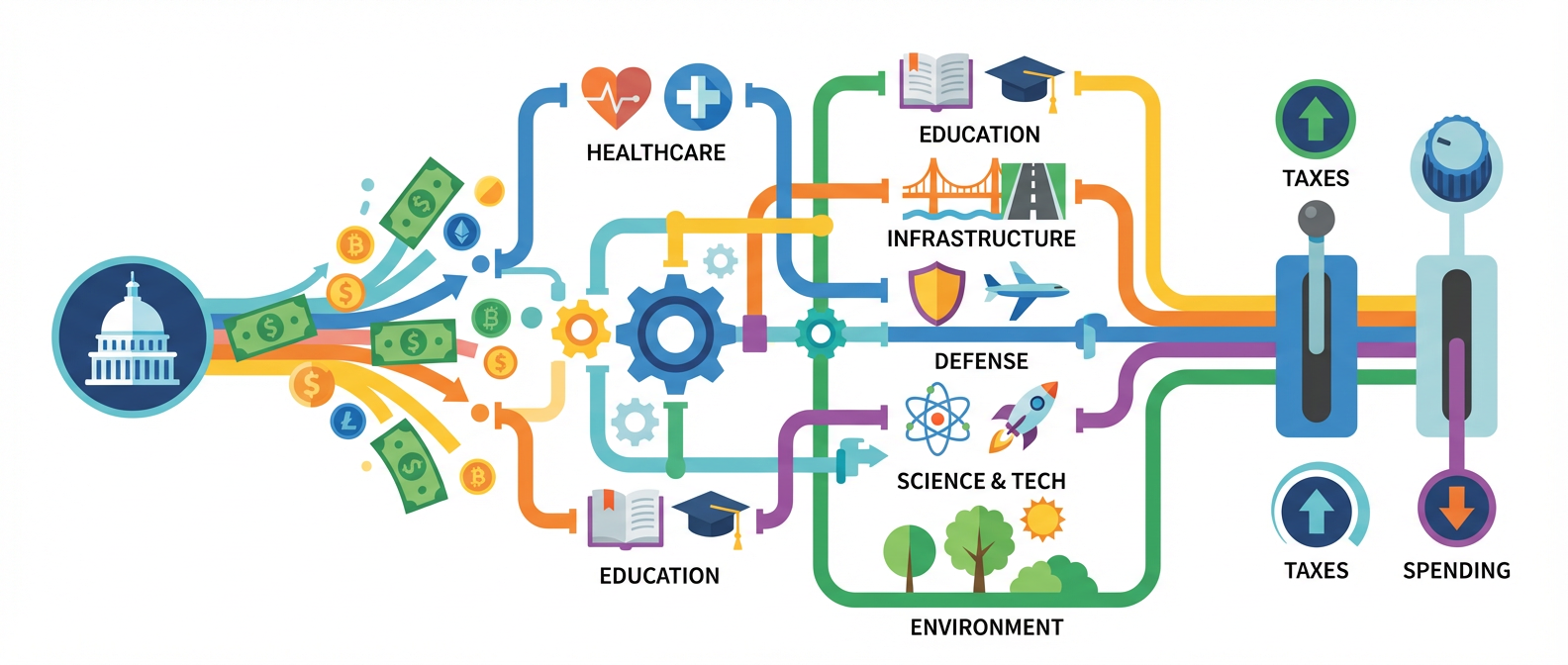
Illustration for Why Budget Baseline Politics Reveals the Illusion of Fiscal Control

The Structural Constraints on Fiscal Policy

Want to understand why real budget cuts are so rare? Look at the incentives facing members of Congress. They get rewarded for bringing visible benefits to their districts while the costs get spread out and hidden. A representative can champion a new veterans’ hospital back home while the bill gets paid through general revenue or borrowing that feels abstract to voters. Benefits are immediate and obvious. Costs are delayed and invisible.

The budget process itself is a mess. Authorization committees set up programs, appropriations committees decide annual funding, and tax committees handle revenue, often without talking to each other much. The House and Senate work under different rules and timelines. We’re supposed to have regular budget procedures, but instead we get continuing resolutions and massive omnibus bills that cram thousands of decisions into must-pass legislation nobody has time to read properly.

Then there’s the government’s role as economic shock absorber. When recessions hit, unemployment insurance and food stamps automatically expand while tax receipts fall, widening deficits exactly when government borrowing makes the most economic sense. Trying to balance budgets during downturns can make recessions worse, as Europe learned the hard way after 2010. This creates tension between simple balanced-budget thinking and sound economic policy.

Why Traditional Deficit Hawks Miss the Mark

The usual deficit reduction talk focuses on debt-to-GDP ratios and annual deficits while ignoring what the government actually spends money on. This treats all government spending as equally wasteful, missing the difference between consumption and investment. Infrastructure, basic research, and education can generate long-term returns that justify borrowing today. Transfer payments and tax breaks for wealthy people probably don’t. What the government spends on matters as much as how much.

Deficit hawks also missed how low interest rates changed everything. When the government can borrow at rates below inflation, which happened often over the past fifteen years, the real cost of debt actually shrinks over time. Look at Japan, which has run persistent deficits with low growth for decades without the fiscal crisis everyone predicted. Or Germany, whose infrastructure crumbled during its balanced-budget phase. The relationship between debt and economic performance is way more complicated than the deficit scolds claim.

Maybe most importantly, deficit reduction usually hurts the wrong people. Spending cuts target programs that help lower-income families, while tax increases that could raise serious money from the wealthy face bigger political obstacles. This creates a trap where deficit reduction takes money away from households that would actually spend it, reducing the economic growth needed to fix long-term budget problems.

A More Sophisticated Approach to Fiscal Policy

Instead of chasing deficit reduction for its own sake, policymakers should think about managing the government’s balance sheet across business cycles. Run bigger deficits during recessions to keep people employed, then build surpluses during good times to cool down the economy and pay down debt. This means giving up the political appeal of balanced-budget slogans for more complex but economically sensible fiscal management.

What the government spends money on matters as much as how much it spends. Investments in infrastructure, scientific research, and education can generate returns that exceed borrowing costs, making them fiscally responsible even when debt-financed. Meanwhile, tax breaks that mostly benefit rich people are hidden spending that gets too little scrutiny. Smart fiscal policy would evaluate all forms of government intervention, including regulations and tax preferences, in one comprehensive framework.

Modern monetary theory, while controversial, points out additional aspects of fiscal policy that traditional analysis misses. The government’s unique ability to issue currency means solvency works differently than for households or businesses. The real limits on government spending are inflation and available resources, not arbitrary debt ratios. This doesn’t mean unlimited spending makes sense, but it suggests fiscal discipline should focus on economic outcomes rather than accounting rules.

Moving Beyond Fiscal Theater

The persistence of baseline budgeting shows something important about American government: our system handles small changes well but struggles with big reforms. The annual budget process, with its manufactured crises and temporary patches, works for incumbent politicians who can claim credit for minor adjustments while avoiding responsibility for long-term trends. Real fiscal reform would require multi-year planning, automatic adjustment mechanisms, and institutional changes that make comprehensive policy evaluation possible.

Breaking out of this pattern means voters need to get smarter about government finance. Just like we expect corporate leaders to create long-term value instead of gaming quarterly earnings, we should pressure elected officials to optimize fiscal policy over business cycles rather than manipulating annual budget numbers. This requires public education about economic complexity and patience with policies whose benefits might not show up for years.

The fake fiscal control created by baseline budgeting undermines democratic accountability by hiding the real choices we face as a society. Citizens deserve honest conversations about the tradeoffs in government spending and the economic logic behind fiscal policy decisions. Only by moving past the theater of deficit politics can we build fiscal institutions worthy of a mature democracy facing real long-term challenges.

The Federal Budget as Constitutional Architecture: Why Allocation Debates Reveal Deeper Structural Tensions

The Illusion of Simple Choices in Complex Systems

When politicians debate federal budget allocations, the public discourse typically frames these decisions as straightforward moral choices: Should we spend more on defense or education? Infrastructure or debt reduction? Healthcare or tax cuts? This framing, while politically useful, hides the profound structural complexities that govern how federal dollars actually move through the American political system. The federal budget isn’t just a large household budget scaled up. It’s not simply a reflection of national priorities expressed through democratic will. It’s a complex constitutional and institutional mechanism that reveals fundamental tensions between competing visions of federalism, democratic representation, and economic governance.

The Federal Budget as Constitutional Architecture: Why Allocation Debates Reveal Deeper Structural Tensions

The complexity begins with the basic architecture of budget authority itself. Congressional appropriations power, executive branch implementation, and judicial oversight create a system of checks and balances that makes coherent fiscal policy extraordinarily difficult to achieve. Unlike parliamentary systems where budget authority flows directly from electoral mandates, the American system deliberately fragments this power across institutions with different constituencies, time horizons, and incentive structures. The House of Representatives, with its two-year electoral cycle, faces different pressures than the Senate with its six-year terms. Meanwhile, the President operates on a four-year horizon with a national constituency that neither chamber fully represents.

This institutional fragmentation works with what economists call the “common pool problem” in fiscal policy. Individual legislators have strong incentives to secure concentrated benefits for their districts while distributing the costs across the entire tax base. This dynamic, multiplied across 435 House districts and 50 states, creates systematic pressures toward spending that are largely independent of ideological preferences about the proper size and scope of government. The result is a budget process that operates according to its own internal logic, often producing outcomes that satisfy neither fiscal conservatives who want smaller government nor progressives who want more effective government investment.

Illustration for The Federal Budget as Constitutional Architecture: Why Allocation Debates Reveal Deeper Structural Tensions

The Temporal Mismatch Problem

One of the most underappreciated aspects of federal budget allocation is the fundamental mismatch between political time horizons and policy implementation cycles. Most significant government programs require years or decades to show measurable results, while political accountability operates on electoral cycles measured in even-numbered years. This temporal disconnect creates perverse incentives throughout the system. Politicians get rewarded for policies with immediate visible benefits over those with larger long-term payoffs. Infrastructure spending illustrates this dynamic perfectly: the ribbon-cutting ceremony happens within an electoral cycle, but the economic benefits of improved transportation networks accumulate gradually over decades.

The mismatch becomes even more problematic when we consider how different types of government spending work with economic cycles. Discretionary spending, which includes most domestic programs outside of entitlements, operates on annual appropriations cycles that line up poorly with both economic downturns and long-term investment needs. When recession hits, tax revenues decline precisely when counter-cyclical spending might be most beneficial. But the political pressure to reduce deficits often grows at exactly the same moment. This creates a structural bias toward pro-cyclical fiscal policy that amplifies economic volatility rather than smoothing it.

Mandatory spending programs (primarily Social Security, Medicare, and Medicaid) operate on different temporal logic entirely. These programs grow according to demographic trends and healthcare cost inflation that unfold over decades, largely independent of annual political decisions. The result? A federal budget where roughly two-thirds of spending operates on automatic pilot. This reduces the scope for active fiscal policy while creating long-term fiscal pressures that current political institutions are poorly equipped to address. The Congressional Budget Office’s long-term projections show these programs consuming an ever-larger share of federal resources, but the political system lacks effective mechanisms for making the difficult choices this trend requires.

Federalism and the Geography of Fiscal Impact

Federal budget allocation operates within a federal system where states retain significant policy autonomy. This creates complex interactions between national fiscal policy and state-level governance. Federal spending programs must work through state governments, nonprofit organizations, and local institutions that have their own priorities, capabilities, and constraints. This creates what political scientists call “implementation gaps” where federal intent diverges from local reality. Medicaid is a perfect example: although funded jointly by federal and state governments, the program operates according to 50 different state plans with varying eligibility requirements, benefit levels, and administrative approaches.

The geographic distribution of federal spending reveals another layer of structural tension. States contribute to federal revenues roughly in proportion to their economic activity, but federal spending flows according to different logics entirely. Defense spending concentrates in states with major military installations and defense contractors. Agricultural subsidies flow to rural states regardless of their overall economic productivity. Disaster relief responds to geographic vulnerability rather than fiscal contribution. Social spending reflects demographic patterns of poverty, age, and disability that correlate imperfectly with state contributions to federal revenue.

These patterns create what economists call “fiscal externalities” where the benefits and costs of federal programs fall on different constituencies. A state might receive significant benefits from federal highway spending while contributing relatively little to federal highway trust fund revenues, or vice versa. Over time, these imbalances become embedded in regional economic development patterns and political coalitions, making budget reallocation efforts inherently redistributive across geographic lines. This geographic dimension helps explain why federal budget debates often break down along regional rather than purely ideological lines, with representatives from affected areas forming coalitions that cross party boundaries.

The Democratic Representation Challenge

Perhaps the most profound structural issue in federal budget allocation involves the relationship between democratic representation and fiscal authority. The Constitution establishes the principle that taxation requires representation, but the modern federal budget operates through mechanisms that complicate this relationship in fundamental ways. Deficit spending allows current voters to consume government services while deferring the fiscal burden to future voters who cannot participate in current elections. This creates what economists call “fiscal illusion” where the apparent cost of government services diverges systematically from their true cost.

The representation challenge extends beyond questions of future generations to questions of democratic equality within the current electorate. The Senate’s equal representation of states regardless of population means that budget decisions effectively weight some voters’ preferences more heavily than others. Wyoming’s 580,000 residents have the same Senate representation as California’s 39 million, giving Wyoming voters roughly 67 times more per-capita influence over federal budget decisions. When combined with the geographic concentration of economic activity in major metropolitan areas, this creates systematic over-representation of rural interests in fiscal policy, even as urban areas generate disproportionate shares of federal revenue.

Interest group influence further complicates the representation picture. Federal budget allocation affects concentrated interests with strong incentives to invest in political influence, while imposing diffuse costs on general taxpayers with weak incentives to monitor specific programs. This dynamic, which economists call “rational ignorance,” creates systematic biases toward particularistic spending that benefits well-organized interests at the expense of general public welfare. The result is a budget process that often operates more like a negotiation between organized interests than a democratic deliberation about public priorities.

Toward Structural Understanding

These structural complexities suggest that debates over federal budget allocation cannot be resolved through appeals to simple principles or moral arguments alone. The American fiscal system embeds multiple competing values (democratic representation, federalism, economic efficiency, and fairness across time) within institutional arrangements that make trade-offs between these values inevitable. Effective fiscal policy requires not just good intentions but institutional mechanisms capable of managing these inherent tensions.

Understanding federal budget allocation as a structural challenge rather than a series of discrete policy choices opens space for more productive political discourse. Rather than debating whether particular spending levels are too high or too low in some abstract sense, we might focus on whether existing institutional arrangements produce the kinds of democratic deliberation and long-term thinking that effective fiscal governance requires. This perspective suggests that budget reform efforts should focus as much on process and institutional design as on specific spending levels or programmatic choices.

The complexity revealed by structural analysis shouldn’t discourage democratic engagement, but it should inform it. Citizens who understand how institutional incentives shape fiscal outcomes are better positioned to evaluate not just what politicians promise but whether existing institutions can deliver on those promises. I’m curious: What aspects of this analysis resonate with your own observations of how federal spending actually works in practice? How might these structural insights inform your thinking about upcoming budget debates?

Page 11 of 15