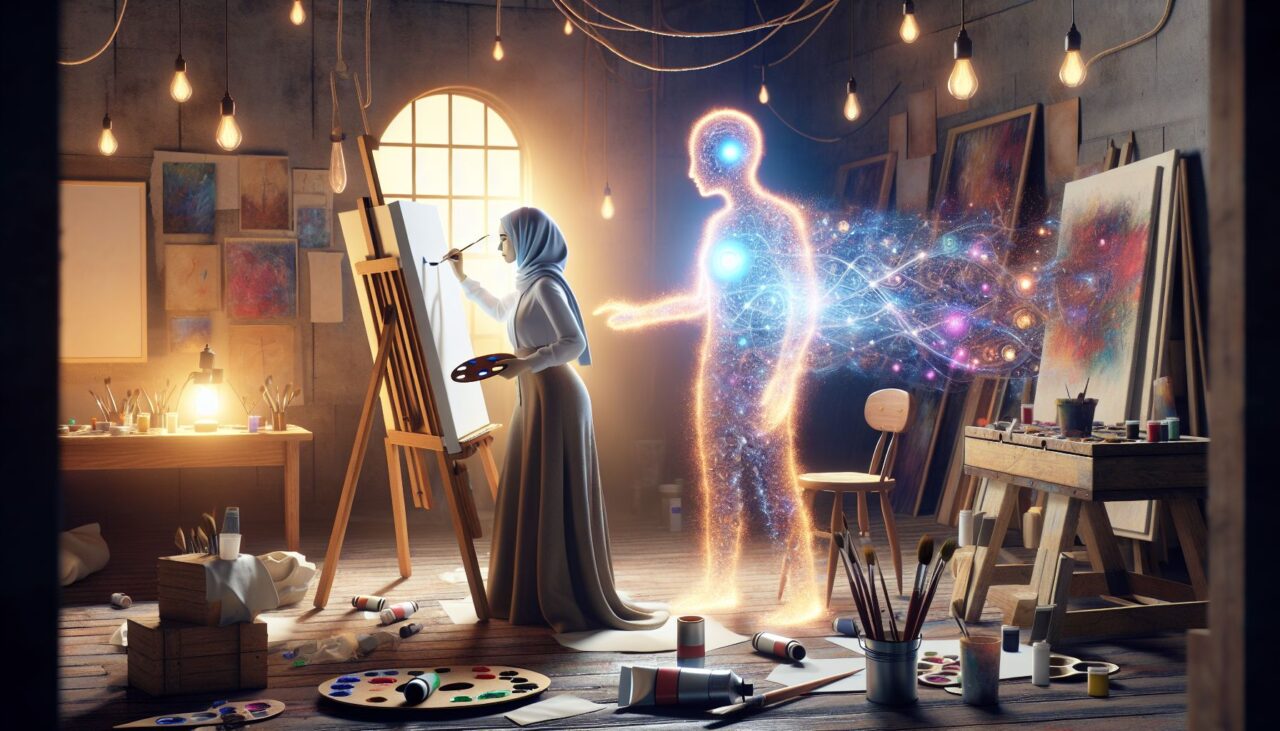
Welcome to another adventure into the thrilling world of technological breakthroughs! Today we’re diving headfirst into an area that’s not just techy, but also artsy. Yep, you guessed it—Artificial Intelligence in the realm of creative arts. It’s like when your favorite arcade game meets a dreamy art gallery. Who would’ve thought our futuristic AI pals could turn into our creative muses? Grab a cuppa, and let’s explore how AI is shaking up the creative universe.
The Dawn of Machine Artists
I’ve always been fascinated by the idea that machines, typically known for precision and logic, could one day master the beautifully chaotic playground of human creativity. As it turns out, that day is now. AI is stretching its newfound wings in tons of artistic areas, from composing symphonies to painting wild digital art pieces.
A recent project that caught my eye is OpenAI’s DALL-E—a neural network that creates images from text descriptions. This isn’t your average photo generator, folks. We’re talking about bizarre pieces, like a two-headed flamingo wearing a tux, all born from cleverly coded algorithms. If you told artists from even a decade ago that machines could pull this off, they’d likely pat you on the back, saying, “Nice sci-fi plot, bud.”
AI as the Composer’s Muse
Now, onto music—an art form that’s as riddled with mystery as it is with melody. Can AI compose tracks that tug at the heartstrings? Thanks to projects like AIVA (Artificial Intelligence Virtual Artist), the answer is remarkably yes. AIVA is busy writing its own symphonies, perfect as background scores for films, giving Hollywood’s human composers some real competition.
And let’s not forget OpenAI’s MuseNet and JukeBox, both mastering musical styles spanning from Mozart to Lady Gaga. Kind of makes you wonder if a musical supergroup with AI is the next inevitable celebrity spectacle. Imagine headlines: “AI Band Drops Symphony Album: Outperforms Mozart Posthumously!”
Algorithms with a Brush
Beyond music, the visual art scene is another canvas where AI is leaving its metaphorical brushstrokes. Platforms like Google’s DeepDream have become household names—or at least digital household names—for converting ordinary photos into psychedelic artworks. GANs (Generative Adversarial Networks) have taken the visual arts a leap further by creating original portrait paintings, some of which have sold at auction for eye-watering sums, rivaling those of their human counterparts.
In a world where everyone and their dog snaps Instagrams like Monet sketches water lilies, AI opens the door to entirely new styles. What if Van Gogh met MATLAB? We’re closer to those colorful starry possibilities than you might think.
The Unexpected Tech Startup Boom
The potential of AI in creative arts hasn’t eluded eager entrepreneurs either. A tech startup ecosystem is growing, with innovative companies hoping to be the next Uber of artistic intelligence. These companies are using AI to democratize creativity. Want to design a fashion line but barely know how to sew on a button? There’s likely a startup chipping away at that problem as you read this.
Take RunwayML, for instance, a startup that offers AI tools for artists and designers. It’s like a genie in your laptop providing everything from style transfer algorithms to green-screen film effects. Who knew digital doodles could have venture capitalists giddy?
The Philosophical Dilemma: Authenticity and AI
While the AI-art saga continues, this narrative isn’t without its quirks and complications. One question we can’t ignore: What makes art truly “art”? Is it the artist’s intent, their angst-filled soul, or could it be an emotionless CPU?
More than a few purists frown upon calling AI outputs “art,” arguing they lack emotional authenticity. A robot, after all, hasn’t stayed up all night pacing and pondering the universe—it’s stayed up processing data. Yet, I’d argue this poses an exciting philosophical debate rather than a dealbreaker. What if the definition of art itself is changing as we integrate technology into every fiber of our lives?
Future Visions: What Lies Ahead?
Considering the rapid pace of innovation, predicting what AI will someday create is as easy as nailing jelly to a wall. But this much I can tell you—we’re at the brink of a technological artistry rebirth. Imagine a world where AI reads your mind to draft your next best-seller or can help amateur illustrators summon a professional touch with just a click.
In the long run, AI might even collaborate with humans not just as a tool but as genuine, self-aware co-creators. Maybe not in our lifetime, but folks, we can dream, can’t we?
Parting Thoughts
The fusion of AI and creative arts opens up a window of opportunity—a new Renaissance, if you will—where technology no longer corners us but empowers us. While challenges like ethical considerations and the essence of creativity linger in the air, the road ahead promises to be exciting, if unpredictable.
As we wrap up today’s exploration, I can’t help but imagine an electric piano played by AI and human fingers coming together to play Beethoven and Daft Punk in perfect harmony. And on that note, to the emerging new breeds of artists—be they carbon-based or silicon-themed—we say harmonize on!
Hope you enjoyed reading as much as I enjoyed writing. Until next time, keep redefining possible and color outside the lines!