Rigorous political analysis for readers who want to understand the system, not just react to it.

Category: My Blog Page 9 of 15

When Words Break: Translation and the Unmaking of Policy Between French and Arabic

When Words Break: Translation and the Unmaking of Policy Between French and Arabic

Every diplomatic encounter between Paris and the Arab world starts with a quiet, mostly invisible act of translation. The French president says laïcité; the Arabic interpreter, scanning for an equivalent, reaches for ʿalmāniyya. The Moroccan minister speaks of al-ḥaraka al-islāmiyya; the French transcript renders it mouvement islamiste. In that gap, entire universes of meaning shift. Policy debates on migration, secularism, terrorism, even climate funding are routinely reshaped not by ideology alone but by a simple, stubborn fact: French and Arabic do not map onto each other cleanly. This essay is about those misalignments—how they happen, why they stick around, and what they cost all of us.

Open dictionary showing French and Arabic text side by side

The Weight of One Word: Laïcité and Its Arabic Ghosts

Take the French word laïcité. It often gets translated into Arabic as ʿalmāniyya, a term that carries its own long, contested history in the Mashreq and Maghreb. But ʿalmāniyya is not laïcité. The Arabic word, derived from ʿālam (world), echoes a secularism that some perceive as anti-religious, tied to colonial impositions and the dissolution of Islamic legal frameworks in the 19th and 20th centuries. French laïcité, at least in its official 1905 articulation, claims to protect the free exercise of religion while keeping the state neutral. Yet when a French minister defends laïcité before a Tunisian audience, the translation ʿalmāniyya can land like an attack on the very idea of a religiously ordered public life. The debate about the veil in French schools, for example, isn’t just about a piece of cloth; it’s a head-on collision between a French legal concept and an Arabic lexical heritage shaped by Ottoman reforms, Nahda intellectuals, and postcolonial struggles.

The result is a policy debate that often bypasses shared understanding. French officials insist they’re defending republican values; their Arabic-speaking counterparts hear a neo-colonial insistence on cultural erasure. Neither side is entirely wrong, but the translation flattens the distinctions that might make actual dialogue possible.

Islamism, Islam, and the Suffix That Divides

Another slippage keeps showing up with the pair islamisme and islam. In French policy discourse, islamisme denotes political Islam—a modern ideology that seeks to base governance on Islamic principles. The Arabic equivalent is often al-islām al-siyāsī (political Islam) or, more problematically, al-uṣūliyya al-islāmiyya (Islamic fundamentalism). But in French media and political speech, islamiste gets used as a catch-all modifier, attaching itself to anything from a charitable association to a bearded man on the metro. When this word is translated back into Arabic—whether in diplomatic cables, Al Jazeera reports, or Arab League communiqués—it often hardens into an accusation that condemns whole communities.

Arabic distinguishes carefully between islāmī (Islamic, relating to the religion) and islāmawī (Islamist, political). French, by collapsing this distinction in everyday usage, exports a conceptual fog that affects counterterrorism policies. When French intelligence services flag an organization as islamiste, their partners in Morocco or Lebanon may read the label differently—either over-policing religious charities or underestimating genuinely violent groups because the term got diluted. The translation error isn’t just linguistic; it’s operational. It costs lives, or it wastes resources, depending on the day.

Interpreter at a conference table with French and Arabic nameplates

Colonial Ghosts in the Lexicon: From Indigène to Waṭaniyy

You can’t discuss French-Arabic translation without acknowledging the colonial residue baked into many terms. The French word indigène (native), which still appears in historical texts and occasionally in legal contexts concerning overseas territories, has no neutral Arabic equivalent. The closest might be waṭaniyy (national) or ahlī (local, indigenous), but both carry a dignity that indigène systematically stripped away during the colonial period. When French officials, even with benign intentions, describe the populations indigènes of Mayotte or New Caledonia, the Arabic translation can accidentally summon a history of the Code de l’indigénat, forced labor, and legal inferiority.

This linguistic inheritance echoes loudly in contemporary migration debates. The term migrant in French often becomes muhājir in Arabic, but muhājir has a noble Qurʾānic resonance—the early Muslims who fled persecution, the act of hijra. French policy discourse on “fighting illegal migration” (lutter contre l’immigration clandestine) is thus heard in Arabic-speaking communities as an assault on a sacred concept. A Moroccan mother waiting for news of her son who crossed the Mediterranean doesn’t hear a bureaucratic category; she hears a denial of his dignity. Translation here isn’t simply semantic; it’s emotional and political, and it colors how policies land on the ground.

When the State Speaks: Diplomatic Consecutive Interpreting and Its Discontents

High-level diplomacy leans on consecutive interpreting, where a speaker pauses every few sentences to allow the interpreter to render their words. The pressure is crushing, and the margin for error is wide. During the 2017 Macron visit to Algeria, a much-discussed moment happened when the French president referred to colonization as a “crime against humanity” (crime contre l’humanité). The Arabic interpreter chose jarīma ḍidda al-insāniyya, a direct calque that’s grammatically correct but tonally different from the French. In French, the phrase carries the weight of Nuremberg; in Arabic, without the same legal genealogy, it sounded slightly literary, almost abstract. The Algerian press, quoting the Arabic version, debated whether Macron had truly apologized or merely made a philosophical statement. The nuance evaporated, and with it, a chance for a cleaner reckoning.

Similarly, in climate negotiations where France mediates between the European Union and North African states, the term transition énergétique is routinely translated as al-taḥawwul al-ṭāqawī. But the Arabic phrase can imply a total, almost revolutionary transformation, while French policymakers usually mean a gradual, technology-driven shift. When Morocco hears al-taḥawwul al-ṭāqawī, it hears an imperative that might threaten its existing energy subsidies and social contracts. The French side, blind to the translational slippage, wonders why its “reasonable” proposals meet resistance.

Dialect, Diglossia, and the Missing Registers

Arabic is a diglossic language: the written form, Modern Standard Arabic (MSA), differs sharply from the spoken dialects—Darija in Morocco, Derja in Algeria, Tunisian Arabic, Lebanese, Egyptian Masri, and on and on. French, despite its own regional variations, doesn’t have the same chasm between written and spoken forms. When French officials give speeches translated into MSA, they are often speaking in a register that feels formal, even alien, to ordinary Arabic speakers. A French mayor’s message about recycling, translated into MSA and broadcast in a Tunisian neighborhood, can sound like a government edict rather than a civic invitation.

Conversely, when Arabic speakers use dialect in informal diplomacy—a Moroccan minister slipping into Darija during a press conference—the French interpreter, trained only in MSA, can miss the cultural codes. The phrase ḥshūma (shame, modesty) in Darija carries a dense social meaning that ʿār or khajal in MSA don’t fully capture. A policy discussion about women’s rights that ignores this register risks misunderstanding the very communities it aims to reach.

A bilingual French-Arabic street sign in a Mediterranean city

The Long Shadow of the Nahda: How 19th-Century Translation Choices Still Define Debates

The Arab Renaissance (al-Nahḍa) of the 19th and early 20th centuries was a period of intense translation from French into Arabic, as intellectuals in Beirut, Cairo, and Tunis sought to import concepts of modernity. Words like ḥurriyya (freedom), muwāṭana (citizenship), and dustūr (constitution) were either coined or recalibrated during this era, often as direct translations of French terms. But these translations weren’t neutral; they were embedded in anti-colonial struggles and Islamic reformism. Muwāṭana, for instance, was shaped by the Ottoman Tanzimat reforms and the Egyptian nationalist movement, carrying a communitarian dimension that citoyenneté in French, with its Jacobin individualism, lacks.

Today, when French officials promote citoyenneté as a remedy for radicalization in the banlieues, the Arabic translation muwāṭana invokes a different history—one of belonging to an umma (community) as much as to a state. The policy prescription, meant to encourage republican attachment, can instead be heard as an invitation to a form of solidarity that the French state explicitly distrusts. The translation error isn’t a mistake; it’s a historical inheritance that no interpreter can untangle in real time.

Toward a Translation-Aware Policy

What would it look like to design policies that account for these translational complexities? First, it would require admitting that no term is self-evident. A French policy paper on radicalisation would need to specify whether it means taṭarruf (extremism), uṣūliyya (fundamentalism), or something else, and why. Second, it would mean investing in interpreters who are not just bilingual but bicultural—who understand that laïcité in a Lyon classroom feels different from ʿalmāniyya in a Cairo seminar. Third, it would demand humility: the recognition that some concepts may simply not translate, and that the effort to force equivalence can do real harm.

In practice, this might look like joint Franco-Arab working groups that spend real time on terminology before negotiating substance. It might mean that French ministries issue bilingual glossaries that explain, rather than simply equate, key terms. And it might mean that journalists and analysts stop pretending that the English word “secularism” or the French word laïcité can be dropped into an Arabic sentence without a short commentary. We owe more to the words, and to the people who live inside them.

FAQ

Why is laïcité so difficult to translate into Arabic?

The difficulty lies in the distinct historical and legal genealogies of the two concepts. French laïcité emerged from a specific conflict between the Republic and the Catholic Church, aiming for state neutrality. Arabic terms like ʿalmāniyya evolved under Ottoman and colonial pressures and are often associated with the marginalization of Islamic law, giving them a different emotional and political charge.

How do translation errors affect real-world policy outcomes?

They can lead to mutual misinterpretation in diplomatic negotiations, mislabeling in security contexts, and public rejection of well-intentioned programs. For example, a counterterrorism term translated too broadly can stigmatize peaceful religious groups, while a migration term stripped of its cultural resonance can alienate the communities it aims to reach.

Can’t we just use English as a neutral bridge language?

Using English introduces a third layer of historical and cultural baggage without resolving the underlying inequities. English words like “secularism” or “nationality” carry their own imperial histories and do not magically dissolve the Franco-Arabic conceptual gaps. A direct engagement with the two languages, however imperfect, remains essential.

What role do dialects play in translation errors?

Arabic dialects carry social and cultural meanings that Modern Standard Arabic often does not. When interpreters or policymakers ignore dialect, they miss the informal codes that shape public opinion. A term like ḥshūma in Moroccan Darija can signal community norms that a formal translation simply overlooks, leading to policies that feel tone-deaf.

Les Mots Qui Trahissent : How Translation Errors Between French and Arabic Reshape Policy Debates

The distance between ‘laïcité’ and ‘ʿalmāniyya’ isn’t measured in centimetres. You’re dealing with centuries of piled-up law, theology, and what actually happens on the street. A French minister announces that the republic does not recognise communities; an Arabic-language newspaper writes that the state is rejecting religious belonging altogether. A political earthquake ripples across the Mediterranean, and almost nobody traces the fault line back to a single dictionary entry.

Open bilingual dictionary with French and Arabic text side by side

I’m Nadia Bassam. I write from the place where Maghrebi memory tangles with Levantine syntax, where a childhood split between Marseille and Beirut hammered home a single truth: the same word can be a shield in one language and an open wound in another. This essay picks apart three moments when French-Arabic translation errors didn’t just cause awkward silences—they restructured policy debates. This isn’t a collection of fun anecdotes. It’s about how power travels across unequal linguistic ground, and what gets broken along the way.

The Grammar of Secularism: ‘Laïcité’ and Its Arabic Double

French laïcité is a legal architecture, brick by brick. The 1905 law separating church and state, the 2004 ban on conspicuous religious symbols in public schools, decades of rulings from the Conseil d’État—it all presumes a very specific deal between the individual citizen and the republic. The state protects freedom of conscience by training itself to ignore confessional identity in the public square. Whether that ignorance is genuinely neutral or just a well-disguised Catholic inheritance is a question for another day, but the legal machinery is precise.

Arabic has no single word that carries that entire scaffolding. The usual suspect is ʿalmāniyya (علمانية), from ʿālam (world)—think worldliness, philosophical secularism. But ʿalmāniyya came up through its own history: nineteenth-century Nahda intellectuals reading French laïcité through Ottoman reformism, then mid-twentieth-century Baathist regimes swinging it like a club against Islamist opponents. The word often smells like state hostility to religion, not institutional separation. So when a French official says “we are defending laïcité,” an Arabic-speaking audience might hear “we are defending anti-clerical authoritarianism.” The policy fallout is instant: statements meant to soothe French secularists throw petrol on Islamist discourse in North Africa, while Arabic-language rebuttals land in Paris like attacks on republican values themselves.

Minaret and church tower visible in the same urban skyline, divided by a narrow street

The 2016 Burqini Affair: A Case Study in Mistranslated Outrage

In the summer of 2016, around thirty French municipalities decided to ban the burqini from public beaches. Mayors reached for laïcité, public order, hygiene. International Arabic-language outlets—Al Jazeera, Al Arabiya—translated the justifications using variants of manʿ al-ḥijāb (منع الحجاب), literally “the prohibition of hijab.” Just like that, the burqini became a stand-in for all Islamic veiling. The French interior minister’s careful phrasing about “ostentatious religious symbols” morphed into headlines screaming that France was outlawing how Muslim women dress.

This wasn’t just sloppy work. Arabic doesn’t have a neat equivalent for “burqini” because the garment itself is an Australian invention with zero roots in Islamic dress history. Translators grabbed the nearest cultural handle—ḥijāb—and in doing so they yanked on decades of postcolonial grievance: French Algeria’s unveiling campaigns, the 2004 headscarf law, the 2010 full-face veil ban. What was a local administrative measure suddenly read as a civilisational slap. Policy debates inside the Arab League and the Organisation of Islamic Cooperation went rigid, diplomatic notes flew back and forth, and French diplomats found themselves defending a municipal bylaw as though it were a constitutional amendment.

‘Communauté’ and ‘Ṭā’ifa’: When Administrative Categories Become Sectarian Weapons

French republican discourse refuses communauté as a legal category. The state knows individuals, not groups. Communautarisme is a dirty word—a stand-in for the supposed Anglo-Saxon model of identity politics that threatens to shatter the indivisible republic. The lexical choice is deeply ideological: France obviously has communities—Breton, Corsican, Jewish, Muslim, gay—but the word is exiled from official speech.

Arabic has mujtamaʿ (مجتمع) for society in a broad sense, but the word that maps most closely onto a bounded religious or ethnic group is ṭā’ifa (طائفة). And ṭā’ifa drags a heavy cart: the Ottoman millet system, Lebanese confessionalism. It’s not a neutral sociological term. It’s a political entity with leadership structures, personal status laws, and a long memory of armed mobilisation. When French politicians condemn communautarisme, Arabic translators frequently reach for ta’ifiyya (طائفية)—sectarianism, the very thing that fuelled Lebanon’s fifteen-year civil war.

Elderly man reading a newspaper in a Beirut café, French and Arabic headlines visible on the front page

Look at President Macron’s 2020 speech on “Islamist separatism,” later dressed up as the law reinforcing republican principles. Macron described neighbourhoods where “communitarian logics” were replacing republican belonging. The phrase logiques communautaires travelled through Agence France-Presse’s Arabic wire as manṭiq ṭā’ifī (منطق طائفي), literally “sectarian logic.” Arab commentators instantly drew lines to Lebanese militia talk. Moroccan Islamist parties accused France of importing a Mashreqi obsession with confessional quotas into a Maghrebi context where it made no historical sense whatsoever. The French original was clumsy but aimed at describing social withdrawal. The Arabic version described the warm-up to armed conflict.

The Colonial Archive Inside the Words

None of these failures makes sense unless you sit with an uncomfortable fact: French-Arabic bilingualism was never a symmetrical affair. It was built inside colonial administration—Algeria (1830–1962), protectorate governance in Morocco and Tunisia (1881–1956), Mandate rule in Syria and Lebanon (1920–1946). French officers and ethnographers produced dictionaries that encoded their administrative needs. Terms for taxation, military conscription, tribal hierarchy got meticulous treatment; vocabulary for Islamic jurisprudence was filtered through a lens of “customary law” built to bypass sharia courts.

Modern translation inherited this colonial lexicography. The Arabic word dawla (دولة) today means “state,” but in premodern usage it meant “dynasty” or “turn in power”—much closer to the cyclical understanding of rule you find in Ibn Khaldun’s Muqaddima. French administrators translated dawla as État and then imposed the European concept of territorial sovereignty onto political formations that had always operated through networked allegiance. When a contemporary French diplomat talks about “state-building” in the Sahel, and an Arabic-speaking audience hears binā’ al-dawla, the two sides are picturing fundamentally different objects: one imagines Weberian institutions, the other a regime’s survival cycle. Counterterrorism strategies stumble, partly because the word “state” never lands on the same reality.

‘Liberté’ and ‘Ḥurriyya’: Individual Right or Collective Liberation?

French liberté is the first word of the republican triptych, chiselled onto every school façade. It’s an individual right, shielded against state overreach, anchored by the Declaration of the Rights of Man. The Arabic ḥurriyya (حرية) shares a triliteral root with taḥrīr (تحرير), liberation. It carries a collective weight, inherited straight from anticolonial struggle: ḥurriyya is what the nation achieves when it kicks out the occupier, not simply what the citizen enjoys inside a constitutional frame.

This isn’t academic hair-splitting. In 2015, after the Charlie Hebdo attacks, French officials framed the security response as a defence of liberté d’expression. Arabic-language solidarity statements, including those from Al-Azhar and the Arab League, used ḥurriyya al-taʿbīr (حرية التعبير). But the resonance was miles apart: French audiences heard Voltaire and the Enlightenment; Arabic-speaking audiences heard bitter old arguments about whether colonial France had ever genuinely extended free expression to its Muslim subjects—just look at the 1881 press laws and how selectively they were applied in Algeria. The translation worked on the surface and collapsed entirely at the historical depth.

When Translators Become Policy Actors

Professional interpreters working EU-Arab League summits, UN mediation in francophone Africa, bilateral Franco-Algerian commissions—they aren’t neutral pipes. They make split-second choices that bend diplomatic outcomes. The French phrase zone de non-droit (literally “lawless zone,” used to describe disadvantaged suburbs) has been rendered into Arabic as manṭiqa khārija ʿan al-qānūn (منطقة خارجة عن القانون), which suggests territorial secession rather than a collapse of state services. Algerian diplomats have objected to this phrasing in closed sessions, arguing it revives the colonial discourse of bled es-siba (lands of dissidence) versus bled el-makhzen (lands of government). The interpreter’s lexical choice detonates into a diplomatic incident.

Another example: the Arabic term muqāwama (مقاومة), resistance, carries unambiguously positive weight as legitimate struggle against occupation. French foreign policy draws a line between “resistance” (acceptable under international law in occupied territories) and “terrorism” (never acceptable). But when Arabic-language statements from Hezbollah or Hamas use muqāwama, French media and politicians often translate it flatly as résistance, without the legal footnotes, and inadvertently grant legitimacy to armed actions the Quai d’Orsay condemns. The translation bulldozes the very distinction policy demands.

The Material Cost of Semantic Drift

These aren’t intellectual embarrassments you can shrug off over coffee. They have material weight: visa policies tightened because of misread statements, development aid redirected after garbled ministerial communiqués, military operations launched on intelligence reports translated without cultural competence. During the 2013 French intervention in Mali, Opération Serval, Arabic-language leaflets dropped over northern towns promised ḥimāya (حماية), protection. Paris intended “we are here to shield civilians from jihadist groups.” But in the Sahelian dialect of Hassaniya Arabic, ḥimāya dragged a strong memory of the colonial protectorat—a legal status that had gutted local sovereignty. Villagers read those leaflets as announcing a new colonial tutelage, and some fled toward militant-held areas instead of toward French lines. A word Paris thought meant safety meant subjugation to the people standing on the ground.

FAQ: Translation and Policy Between French and Arabic

Why does ‘laïcité’ cause so much confusion in Arabic-language media?

Because laïcité is a specific French legal doctrine that separates religious institutions from the state while protecting individual freedom of conscience. The standard Arabic translation, ʿalmāniyya, carries connotations of anti-religious state ideology shaped by Ottoman and Baathist history. The gap between institutional separation and philosophical worldliness creates systematic misunderstanding whenever French secular policies are reported in Arabic.

Can professional translators prevent these policy distortions?

To an extent, yes. But the problem runs deeper than swapping terms. Many key concepts—communautarisme, zone de non-droit, liberté—have no exact equivalents because they are embedded in French republican history. Skilled translators can add explanatory glosses, but tight deadlines, headline constraints, and the political agendas of media outlets mean precision is often sacrificed. The colonial legacy of French-Arabic bilingualism also means that dictionaries and training materials still reflect administrative priorities from the protectorate era.

How does the colonial history of translation affect current diplomacy?

French-Arabic translation was developed as a tool of colonial governance, designed to administer populations, levy taxes, and codify “customary” law. This history left a lexicographical inheritance that maps European political concepts onto Arab realities without accounting for indigenous meanings. When contemporary diplomats rely on this inherited vocabulary, they reproduce colonial-era assumptions about state, community, and law, often undermining policy goals in North Africa and the Levant.

The Mediterranean is a sea of mistranslated intentions. Until policy institutions invest in historical and dialectal literacy—not just linguistic competence—we will keep mistaking a swimsuit for a creed, a dynasty for a state, a call for protection for a declaration of war. The words matter because the bodies do.

Lost in Diplomatic Translation: How French-Arabic Misunderstandings Reshape Policy Debates

Vintage typewriter with French and Arabic manuscript pages scattered on a wooden desk, symbolizing cross-language communication
Le poids des mots, le choc des interprétations. A visual metaphor for the stakes of Franco-Arab translation.

I still remember the exact moment, sitting in a conference room in Beirut, when a seasoned French diplomat used the term « laïcité » to describe a proposed educational reform in Lebanon. His local counterpart, a former minister educated in both Paris and Cairo, nodded politely. Afterwards he whispered to me: “He thinks he’s talking about constitutional neutrality. In Arabic, we heard ‘al-‘almāniyya’—and for many in this room, that carries the ghost of colonial imposition, not liberation.”

That slip, barely a second long, captures a much larger pattern. We tend to treat translation errors as clerical glitches, minor frictions that smooth out over time. But in the dense, multilingual corridors where French and Arabic policy debates intersect, mistranslation isn’t a glitch. It’s a structural force. It shapes military accords, migration pacts, entire frameworks of cultural cooperation. I’ve spent two decades navigating both linguistic worlds—as a researcher, interpreter, and occasional unwilling witness to diplomatic faux pas. What follows is an honest account of what happens when French and Arabic words bend, break, or get deliberately twisted in the service of power.

The Grammar of Political Ambiguity

French and Arabic do not simply map onto each other. The political lexicon of each language grew from radically different soil. Modern French diplomatic vocabulary was refined in the halls of the Quai d’Orsay and the salons of the Third Republic, carrying assumptions about statehood, secularism, and citizenship that assume a certain European trajectory. Arabic, meanwhile, draws on a classical well of jurisprudential and poetic terms that were recalibrated during the Nahda—the 19th-century Arab renaissance—to engage with modern concepts of sovereignty, nationhood, and rights. It did this through a deliberate negotiation with Ottoman, French, and British vocabularies.

Consider the word “État” (state). In French, it’s a familiar, almost banal administrative container. But when a French official says “l’État de droit” (the rule of law state), the Arabic rendering often becomes « dawlat al-qānūn » or, more problematically, « dawlat al-qawānīn ». The first sounds technical; the second, with its plural form, can evoke an image of a state drowning in arbitrary regulations, not one governed by legitimate law. I’ve seen this single translational wobble prolong negotiations over judicial reform clauses in bilateral treaties between France and North African governments. Each side thought they were agreeing on the same principle. The emotional and historical resonance of the Arabic phrasing planted seeds of suspicion that surfaced months later.

Then there’s the term “sécurité”. In French, it slides easily between safety, security, and stability. Arabic distinguishes between « amn » (security in the sense of public order) and « salāma » (safety, well-being). When a French interior minister speaks of “sécurité intérieure” and it’s translated as « al-amn al-dākhilī », the Arab audience hears a focus on policing and surveillance. « al-salāma al-dākhiliyya » would have evoked protection of citizens’ welfare. The choice is political, and it’s often made by a harried interpreter under pressure, without the time to weigh the historical freight of each option.

Close-up of a bilingual French-Arabic dictionary with handwritten notes in the margins, resting on a diplomat's desk
Les dictionnaires ne suffisent pas. Translation is an act of cultural negotiation, not just lexical matching.

Colonial Echoes in Everyday Lexicon

No discussion of Franco-Arab translation can bypass the colonial sediment that clings to certain words. The French protectorate period in Morocco, Tunisia, and the Levant left a layer of terminology that still circulates in policy documents. When a French development agency speaks of « mise en valeur » (development, literally “putting into value”), it echoes the colonial doctrine of mise en valeur des colonies—a concept that justified resource extraction under the guise of improvement. The Arabic equivalent, « tanmiya », carries none of that paternalistic residue; it means growth, cultivation, something organic. Yet the French phrase keeps appearing in translated reports. Its familiarity to Francophone elites in the Arab world can anaesthetize them to the power dynamic it recalls.

Similarly, the term “communauté” sits uncomfortably between the two languages. In French republican discourse, it’s often a suspect category, associated with communautarisme—the dreaded fracturing of the indivisible nation. In Arabic, « jaliya » or « mujtama‘ » can simply denote a diaspora community or a social group without the same pejorative charge. When French policymakers discuss “les communautés musulmanes” in France, the translation into Arabic for media consumption in the Maghreb can inadvertently reinforce a narrative that France is actively fragmenting its Muslim population into manageable ethnic blocs. The French intention may be descriptive; the Arabic reception is often suspicious, shaped by decades of postcolonial memory.

When Religious Terminology Crosses Borders

The most volatile mistranslations cluster around religion. The French concept of « laïcité » is notoriously untranslatable—not because Arabic lacks words, but because the French experience of separating church and state is so historically specific. The standard Arabic rendering, « ‘almāniyya », comes from ‘ālam (world), implying a turn toward the worldly or secular. But for many Arabic speakers, ‘almāniyya is haunted by the memory of authoritarian regimes that used secularism as a weapon against religious expression. When a French minister says “laïcité est notre socle commun” (secularism is our common foundation) and it becomes « al-‘almāniyya hiya asāsunā al-mushtarak », the Arab listener may hear an echo of a past they associate with repression, not neutrality.

A more constructive path exists, though it’s rarely taken. Some translators, aware of this pitfall, use « ‘almāniyya maftūha » (open secularism) or even borrow the French word as « lā’īkīyya », a neologism gaining ground in Lebanese and Tunisian intellectual circles. Such nuance rarely survives the rushed press release or the 30-second news clip. The result: a policy conversation in which France believes it’s exporting a model of religious freedom, while the Arab public sphere receives a message about the suppression of religious identity.

A diplomatic conference room with French and Arabic nameplates, microphones, and scattered translation earpieces
Dans les coulisses des négociations, les écouteurs de traduction simultanée peuvent devenir des vecteurs de quiproquos géopolitiques.

Migration and the Terms of Belonging

The language of migration policy offers a daily laboratory of distortion. Take the French term « intégration ». In French official discourse, it suggests a reciprocal process by which newcomers adopt the values of the Republic while enriching it. In Arabic, the common translation « indimāj » tilts toward assimilation—a dissolving of one’s original identity into the host society. The distinction is subtle but explosive. When a French prime minister declares that “l’intégration progresse” (integration is advancing), the Arabic media may report it as “al-indimāj yataqaddam”, conjuring images of cultural erasure. For North African families who have lived in France for three generations, this translation choice can wound and mobilize.

Conversely, the Arabic term « mushāraka » (participation) would more accurately capture the French ideal of active citizenship without implying the loss of one’s heritage. Yet it’s almost never used in official translations, probably because it lacks the bureaucratic familiarity of indimāj. The habit sticks, and with it, a subtle poison enters the public debate on immigration.

The Unseen Agency of the Interpreter

We rarely talk about the human beings inside the translation booth. In my observation, interpreters working French-Arabic diplomatic meetings often come from specific backgrounds: many are Lebanese or Egyptian, educated in French-medium schools, carrying their own relationships to both languages. Their choices are constrained by time, but also by the unspoken expectations of the principals they serve. A French diplomat may expect a certain decorum, a certain secular frame; an Arab minister may signal, through a raised eyebrow, that a particular rendering is unwelcome. The interpreter navigates this minefield in real time, and their micro-decisions accumulate into macro-outcomes.

One interpreter I know, a woman from Casablanca, once told me she deliberately avoids the word « jihād » in any context, even when a French speaker uses “jihad” to refer to armed extremism. She replaces it with « irhāb » (terrorism) or a descriptive phrase, because she knows that for many Arabic speakers, jihād has a much broader, non-violent spiritual meaning. She’s not merely translating; she’s intervening to prevent a term from being semantically hijacked. Her choice is invisible to the official record, but it shapes the conversation.

Toward a More Honest Multilingualism

The solution is not to produce perfect translations—that’s a fantasy. It’s to recognize publicly that translation is a site of political negotiation, not a neutral conduit. French and Arab policymakers should be trained to pause at key terms and ask: what does this word really mean in the other’s historical experience? Could we agree on a shared glossary before signing a document? Such practices already exist in some international organizations, but they’re treated as bureaucratic tedium rather than as essential diplomatic hygiene.

We also need more public conversation about these mistranslations. Journalists covering Franco-Arab relations rarely quote the original French or Arabic side-by-side; they collapse the difference in the name of readability. But readability at the cost of accuracy is a disservice to citizens who deserve to know when a policy debate is being shifted by a linguistic sleight of hand.

France’s relationship with the Arab world is constantly redefined—by security partnerships in the Sahel, by energy negotiations with Gulf states, by the internal tensions of French society itself. In this landscape, the quality of translation isn’t a peripheral concern. It’s the very texture of diplomacy. Until we treat it as such, we’ll keep mistaking the echo of our own words for a genuine dialogue.

Frequently Asked Questions

Why are translation errors between French and Arabic more consequential than between other language pairs?

The French-Arabic linguistic relationship carries a heavy colonial history that other pairs may not. Many French political terms were imposed during the protectorate era, and their Arabic “equivalents” were often coined under unequal power conditions. This means a mistranslation today can reactivate historical wounds and reshape trust in ways that, say, a French-English error rarely does.

How does the concept of “laïcité” get distorted in Arabic?

The standard Arabic translation, ‘almāniyya, is associated with state-imposed secularism under authoritarian Arab regimes. When French officials use laïcité to mean religious neutrality and freedom, the Arabic term can evoke repression and the erasure of religious identity. Some translators now experiment with lā’īkīyya or add qualifiers like maftūha (open) to bridge the gap, but these nuances rarely reach mainstream media.

What can be done to reduce harmful mistranslations in diplomatic contexts?

Diplomatic teams should develop shared bilingual glossaries for sensitive terms before negotiations begin. Interpreters and translators need more time and institutional support to flag problematic renderings. Finally, media reporting on Franco-Arab affairs should, where possible, cite original-language statements alongside translations, so that citizens can see the linguistic choices being made.

Mots Croisés: How Translation Errors Between French and Arabic Reshape Policy Debates

Diplomats in formal attire seated around a negotiating table with documents and pens

We like to believe that policy debate rests on fixed terms. That when a diplomat says “sovereignty” in French, and her counterpart hears siyāda in Arabic, the concept glides across the table intact. In the bilingual mind—my mind—this faith falls apart daily. French carries the juridical dust of the Napoleonic code; Arabic carries the echo of pre-Islamic kinship and the weight of Qur’anic usage. The same word, on two different tongues, can launch two entirely different political projects.

I’m not talking about the obvious mistranslations that make journalists laugh—the faux amis that turn a compliment into an insult. I’m talking about the systematic way that French and Arabic, when rubbed against each other in policy settings, reshape whole frameworks. From Maghreb migration pacts to Levantine ceasefire texts, the gap between what is written and what is understood isn’t a glitch. It’s a force.

A Tale of Two Modernities

Vintage typewriter with a sheet of paper containing text in both French and Arabic scripts

To see why, step back from the negotiating room and into history. French is a language that, from the 17th century onward, was deliberately shaped into an instrument of state clarity. The Académie française, Richelieu’s brainchild, set out to purge ambiguity. Words in French administrative discourse lean toward univocality: one word, one definition, enforceable by decree.

Classical Arabic—and its modern standard descendant—never got that narrowing. It’s a language where a single root can generate a constellation of meanings, each one shimmering with context. Hudna, for example, is often translated as “ceasefire,” but its classical resonance includes a tactical pause that allows for regrouping, a temporary quiet inside an ongoing obligation. French has no equivalent that carries this layered temporal logic. The moment a journalist or a minister renders hudna as cessez-le-feu, the strategic horizon of the term collapses.

When “Secularism” Travels Badly

Few translation errors have reshaped policy as deeply as the rendering of laïcité into Arabic. In French, laïcité is a thick concept, born of a specific struggle against clerical power, codified in the 1905 law on the separation of churches and state. It’s active, institutional, and deeply suspicious of religious visibility in public life.

Arabic typically reaches for ‘almāniyya (from ‘ālam, world) or ilmaniyya (from ‘ilm, science). Neither carries the anticlerical charge of the French term. ‘Almāniyya points toward “worldliness” or “this-worldly orientation”; ilmaniyya toward “scientific secularism.” Both lack the legal architecture of laïcité. When French officials insist that North African states adopt laïcité as a condition for cultural cooperation, what’s heard across the Mediterranean is often a demand to abandon Islam, not to restructure state-religion relations. The policy debate—on education, on headscarves, on funding for mosques—sours before it begins, poisoned by a translation that smuggles in an entire French history while pretending to be neutral.

The “Community” Trap

Open book with Arabic calligraphy on one page and French text on the facing page

Another fault line runs through the word communauté. In French republican discourse, communauté is often a suspect word. It evokes communautarisme: the dreaded retreat into ethnic or religious identity against the universalist ideal of the Republic. Policy documents carefully avoid recognizing communautés as legitimate political actors.

In Arabic, jamā‘a or mujtama‘ (often both translated as “community” or “society”) carry none of this suspicion. Jamā‘a can refer to a group bound by shared purpose, a congregation, a village council. It’s organic, not ideologically charged. When a French mayor refuses to engage with a “communauté musulmane” on grounds of republican principle, an Arabic-speaking interlocutor may experience this not as a defense of secular universalism but as a refusal to speak with real people who exist. The policy consequence is concrete: integration programs designed in Paris fail in Marseille or Lyon because they’re built on a French semantic anxiety that has no equivalent in the Arabic-speaking households they target.

In North Africa, the relationship between French and Arabic isn’t just translational—it’s diglossic. French remains the language of many legal codes, commercial contracts, and technical regulations, even in states where Arabization policies have been official for decades. Tunisian property law, for instance, still relies on French terminology for concepts that have no stable Arabic equivalent in local jurisprudence.

This creates a two-tier reality. Debates in Arabic-language parliaments often pivot on terms that are themselves translations of French originals, without the speakers fully registering the borrowing. When an Algerian deputy argues about al-milk al-fikrī (intellectual property), she’s invoking a concept built in French legal culture and awkwardly retrofitted onto Arabic lexical roots. The translation error here is structural, not occasional. It means that policy debates in the Maghreb operate on a palimpsest: French legal reasoning, dressed in Arabic vocabulary, debated by people whose lived legal consciousness may draw on Islamic jurisprudence or customary Amazigh law. The result is a permanent blurring of normative horizons, one that external analysts often mistake for incoherence.

The Weight of Untranslated Words

Sometimes the policy reshaping happens not through mistranslation but through the deliberate refusal to translate. Certain Arabic terms—jihād, sharī‘a, khilāfa—are routinely left untranslated in French media and diplomatic cables, as if they were too volatile to touch. This freezes them as exotic threats, rather than terms with complex histories that can and should be rendered into French, even imperfectly.

Jihād, for instance, has a primary meaning of “striving” or “effort” in Arabic, with a military sense that’s secondary and context-dependent. By refusing to translate it, French policy discourse collapses the whole semantic field into the militant sub-meaning. Counter-radicalization programs then get designed against a phantom: a monolithic “jihādism” that no longer corresponds to the variegated ways Arabic speakers actually use the word. The policy error is a translation error, amplified across an entire security apparatus.

Diplomatic Ambiguity as a Feature, Not a Bug

I want to be careful here. Not all translation “errors” are accidents. In multilateral diplomacy, constructive ambiguity is a tool. UN Security Council resolutions are famously drafted in English and French, then translated into the other official languages, with deliberate vagueness baked into the phrasing. Arabic versions of these texts sometimes exploit the polysemy of Arabic roots to leave room for interpretation that the French text forecloses.

The 2006 Lebanon ceasefire resolution is a case in point. The French text spoke of a “cessation of hostilities”; the Arabic rendering used words that could be read as a temporary truce or a permanent halt, depending on the political needs of the reader. Both parties signed the same document, but they signed different linguistic realities. The translation error here isn’t a failure; it’s the very mechanism that allowed the agreement to exist. And yet, the later accusations of bad faith were, at root, arguments about which language held the true meaning.

Migration Terminology: “Refugee” and Its Doubles

In the migration debates that so dominate French-Mediterranean relations, translation errors carry life-altering consequences. The French réfugié maps onto the 1951 Geneva Convention definition, with its strict criteria of well-founded fear of persecution. Arabic has a range of terms: lāji’ (refugee, but also one who seeks shelter), nāziḥ (displaced person, often used for internal displacement), muhājir (migrant, with a resonance of the early Muslim hijra).

When French asylum officers interview Arabic-speaking applicants, the interpreter has to choose a word. The choice shapes the legal hearing. A person who describes himself as nāziḥ may not meet the legal threshold for réfugié, but if the interpreter renders it as réfugié out of habit, the legal frame shifts. Whole protection claims rise or fall on this lexical decision. The policy debate about “false refugees” and “economic migrants” is, at its granular level, a debate about translation practices that remain invisible to the public.

Why This Matters Beyond Linguistics

My point isn’t that we need better dictionaries. It’s that policy debates between the French-speaking and Arabic-speaking worlds aren’t conducted on a level semantic field. The languages carry different histories of state formation, different relationships to religion, different tolerances for ambiguity. When we ignore this, we produce policies that are perfectly coherent in French and perfectly nonsensical in the Arabic-speaking contexts where they’re supposed to operate.

Consider the French politique de la ville (urban policy) exported as a model for banlieues in North African cities. The French term quartier prioritaire (priority neighborhood) gets translated literally, but the Arabic-speaking residents hear a stigma that the French original, already euphemistic, tries to hide. The policy fails not because the urban planning is wrong, but because the words it travels on can’t hold their shape across the Mediterranean. The translation error is the policy error.

A Modest Proposal for Bilingual Policy Thinking

I’m not asking for perfection. No translation is final, and every rendering is an interpretation. What I’m asking for is a policy culture that treats translation as a substantive act, not a clerical one. When a French ministry drafts a white paper on Mediterranean cooperation, the Arabic version should be drafted in parallel, not produced as an afterthought. Bilingual negotiation teams should include people who live in both languages, not just people who studied both languages. And we should be honest about the places where translation fails—let those failures become visible instead of papering them over with a false consensus.

The French Republic’s relationship with the Arabic-speaking world is one of the defining fault lines of the 21st century. It won’t be mended by getting the words exactly right. But it can be made more honest, and more effective, by understanding just how much the words are doing. The next time you read a joint French-Arabic communiqué, ask yourself: are these two texts saying the same thing, or are they two separate policies, bound together by a staple and a wish?

Frequently Asked Questions

Why do translation errors between French and Arabic have such a strong effect on policy?

French and Arabic encode fundamentally different relationships between language and state power. French was deliberately standardized to serve a centralized administration, while Arabic retains a high degree of polysemy rooted in classical and religious traditions. When a legal or diplomatic term crosses between them, it often carries unspoken historical assumptions that can derail negotiations or create policies that work in one cultural frame but fail in another.

Can’t professional interpreters solve these problems?

Professional interpreters are essential, but they work under constraints that limit their ability to bridge deep conceptual gaps. They must produce immediate, concise renderings, often without the time to explain that a given Arabic term has no single French equivalent. In addition, many policy texts are translated in writing by teams that lack the bilingual cultural immersion necessary to catch the false friends and historical mismatches described in this article. The solution is less about interpreter skill and more about designing policy processes that acknowledge translation as a site of political negotiation in its own right.

Does this mean that French and Arabic are inherently incompatible in diplomacy?

Not at all. In some cases, the gap between the two languages has been used productively, as in UN resolutions where constructive ambiguity allows parties to sign the same text while understanding it differently. The problem arises when policy actors treat the two languages as if they map onto each other perfectly, ignoring the divergences. A more bilingual policy culture would embrace the incompatibilities as a resource for flexibility, while being transparent about where the meanings diverge.

When Words Warp: How Translation Errors Between French and Arabic Reshape Policy Debates

In November 1967, the United Nations Security Council adopted Resolution 242, intended to chart a path toward peace in the Middle East. The English text called for “withdrawal of Israeli armed forces from territories occupied in the recent conflict.” The French version read “retrait des forces armées israéliennes des territoires occupés lors du récent conflit.” That single definite article—”des” versus the absence of “the”—ignited a debate over whether Israel must withdraw from all territories or some territories. Arabic-speaking diplomats, working from yet another version, read the resolution as demanding complete withdrawal. Half a century later, the ambiguity born of that translation gap still echoes in negotiation rooms from Geneva to Riyadh.

Documents and papers spread across a desk with multilingual text

Language Is Never Neutral

Between French and Arabic, translation is not a mechanical act of substitution. It is a political gesture. Each language carries centuries of imperial encounter, colonial administration, and post-independence renegotiation. When a French diplomat says laïcité, the word arrives weighted with a specific republican tradition that has no direct equivalent in Arabic. When an Arabic-speaking official uses مقاومة (muqāwama, resistance), French media often render it as terrorisme or extrémisme, stripping the term of its political and historical register. The gap between what was said and what was heard reshapes policy before any vote is cast.

I grew up moving between Beirut and Paris, and I learned early that the same conversation sounds different depending on the language in which it unfolds. My grandmother would recount the same event in Arabic and in French, and the framing shifted—the actors bore different motivations, the stakes sat at different heights. This was not dishonesty. This was the texture of bilingual life, where meaning lives in the space between tongues.

The Colonial Dictionary Still Speaks

French colonial administration in the Maghreb and the Levant did not merely govern; it classified. The Bureau des affaires indigènes produced glossaries, ethnographic reports, and legal codes that translated local governance structures into French administrative categories. The Arabic جماعة (jamāʿa, community or congregation) became tribu in colonial documentation, a word that carried the assumption of pre-modern fragmentation. That translation decision justified the politique des races—dividing populations along “tribal” lines to weaken nationalist movements.

When contemporary policy analysts discuss “tribalism” in North Africa or the Gulf, they often reproduce a category born from colonial translation without examining its origins. The Arabic terms for social organization—عشيرة, حمولة, عائلة—denote different scales and kinds of belonging. Collapsing them into tribu erases those distinctions and imports a French evolutionary framework that positions such belonging as an obstacle to modern statehood.

Vintage books and documents on a shelf suggesting historical archives

Contemporary Cases Where Translation Bent Policy

Laïcité and the Headscarf Debates

France’s 2004 law banning “conspicuous” religious symbols in public schools was debated in both French and Arabic media, but the terms of debate were not parallel. In French, laïcité names a constitutional principle with a specific legal genealogy dating to the 1905 law separating church and state. In Arabic coverage, the word was often translated as علمانية (Ê¿ilmāniyya), a term that in Arab political discourse carries associations with authoritarian secularism—specifically the Baathist and Nasserist regimes that persecuted Islamist movements. French commentators then read the Arabic reactions as evidence of religious intolerance, missing the fact that the Arabic term itself had been shaped by different historical wounds.

The policy consequence was real: French legislators, responding to domestic media depictions of Arab reactions, hardened their positions. What might have been a negotiation between legal traditions became a confrontation between civilizational narratives, each built on a translation that concealed more than it revealed.

The “Resistance” Problem

Perhaps no word demonstrates the policy weight of translation more than مقاومة. In Arabic political vocabulary, the term encompasses a range from unarmed popular opposition to armed struggle against military occupation. It carries echoes of anti-colonial movements across the twentieth century. When French media and political figures translate muqāwama uniformly as terrorisme, they do not merely choose a harsh word—they remove the possibility that an Arabic-speaking public might distinguish between organizations on the basis of their actions and political contexts.

This conflation has direct legislative consequences. Laws drafted to combat terrorism in France often define the offense so broadly that they criminalize expressions of political solidarity that would be categorized as legitimate resistance in Arabic-speaking legal traditions. European Court of Human Rights rulings on freedom of expression in cases involving Arabic-language content reveal this tension repeatedly, as judges must decide whether a statement constitutes incitement to violence or a reference to a recognized right under international humanitarian law.

Sovereignty and the State

The Arabic دولة (dawla) and the French État appear in dictionaries as equivalents, but their political resonances diverge. In French republican tradition, l’État carries an aura of permanence and rational authority. In Arabic, dawla has historically referred to dynasty or ruling power—a shift in dawla is a shift in who rules, not a change in an abstract institutional order. When French and Arabic-speaking diplomats negotiate agreements about “state-building” or “sovereignty,” they are not always discussing the same concept.

This disconnection became visible during the Libyan transition discussions in 2011. French officials spoke of rebuilding l’État libyen, invoking a model of centralized republican governance. Many Libyan participants, working in Arabic, invoked dawla in ways that accommodated regional and tribal governance structures that French interlocutors dismissed as feudal. The resulting policy documents reflected the French conception, which then struggled to gain legitimacy among Libyan populations who saw their own political vocabulary excluded from the framework.

Meeting room with chairs around a long table suggesting diplomatic negotiations

Institutional Failures and Their Costs

International organizations that operate in both French and Arabic—The United Nations, the International Organisation of La Francophonie, the Arab League—maintain translation departments, but institutional translation operates under pressure that favors speed over precision. A 2018 internal review at the UN found that Arabic translators handling French-language Security Council resolutions sometimes worked from English intermediary texts rather than the original French, introducing a double layer of interpretation. When the meaning of a ceasefire provision or a sanctions regime depends on the placement of a single preposition, this practice creates legal ambiguity that armed parties can exploit.

The European Parliament faces a related challenge. Arabic-language lobbying materials submitted by civil society organizations from the MENA region are often summarized in French before reaching MEPs, compressing arguments that took pages to develop into a paragraph that may miss the core claim. Policy recommendations arrive pre-filtered through linguistic assumptions that the original authors did not make.

What Bilingual Analysis Requires

Correcting translation-driven distortions in policy debates demands more than better dictionaries. It requires institutional habits that acknowledge the political life of words across linguistic communities.

First, policy documents produced in bilingual or multilateral contexts should include annotated terminology sections that identify where key terms carry different legal or historical charges in different languages. The Helsinki Commission’s practice of publishing parallel-text agreements with commentary on divergent terms offers a model, though it remains underused in Franco-Arabic contexts.

Second, journalism and analysis that address audiences in both languages must resist the temptation to flatten. When a Lebanese newspaper renders laïcité as Ê¿ilmāniyya, it should note the conceptual gap. When a French think tank publishes on “resistance movements” in the Middle East, it must distinguish between organizations that claim the term under international humanitarian law and those that do not.

Third, training for diplomats, journalists, and analysts working across the French-Arabic divide should include historical linguistics—not as an academic exercise, but as a practical necessity for anyone whose job requires them to interpret what another party actually means. The colonial archive, the post-independence constitution, the Friday sermon: each of these sites produces meaning that cannot be captured by substituting one word for another.

Frequently Asked Questions

Why can’t professional translators simply solve this problem?

Professional translators can identify lexical gaps and flag ambiguities, but they work within institutional structures that often prioritize speed and political expediency over terminological precision. A translator at the UN cannot rewrite a Security Council resolution because one term lacks an equivalent in another language. The problem is structural: policy is drafted, debated, and adopted in linguistic environments that assume commensurability where it does not exist. Translators illuminate the gaps; they cannot close them alone.

Are there historical examples where translation errors directly changed a political outcome?

The most cited case remains UN Resolution 242, discussed above. Another is the 1956 Suez Crisis, where English, French, and Arabic statements from the various parties used different terms for the same proposed actions, allowing each side to claim the other had violated agreements. More recently, during the 2015 Iran nuclear deal negotiations, the absence of an official Arabic text meant that Arab states received interpretations filtered through English and French media, shaping their diplomatic responses to a document they had not read in their own language. A thorough account of these cases appears in the United Nations documentation on diplomatic language.

Does the same problem exist between other language pairs?

Yes, though the specific historical weight differs. English-Russian mistranslations during the Cold War produced their own cascade of diplomatic crises. What makes the French-Arabic case distinctive is the colonial relationship: French was imposed as an administrative language across much of the Arabic-speaking world, and the vocabulary produced during that period continues to shape how both languages register political concepts. The asymmetry is not merely linguistic; it is the asymmetry of a former colonial power and formerly colonized populations still negotiating the terms of their relationship.

Refusing the Shortcut

Every translation is an act of interpretation, and every interpretation carries consequences. Between French and Arabic, those consequences land on terrain already scarred by colonial history, occupation, and unequal power. The least we can do—journalists, analysts, diplomats, citizens—is refuse the shortcut that treats translation as a neutral relay. Words do not pass between languages untouched. They arrive transformed, and if we do not attend to how they transform, the policies we build on them will stand on ground we never examined.

Why French Cultural Diplomacy in the Middle East Still Carries Colonial Weight

When Soft Power Remembers Empire

Walk into any Alliance Française from Beirut to Cairo, and you will find a particular tension embedded in the walls. The classrooms are full. The library shelves hold Camus alongside Maalouf. Young professionals study for DALF certifications, chasing opportunities in Francophone networks. Yet beneath the familiar rituals of cultural exchange lies a question that France has never fully answered: how do you separate the language of Voltaire from the language of the mandate?

Group discussion in a cultural institution setting

French cultural diplomacy in the Middle East operates within a historical gravity it cannot escape. The very institutions that claim to bridge civilizations were born from the same imperial logic that carved the Levat into protectorates, that imposed French legal codes on Ottoman subjects, that treated Arabic as a language of the governed rather than the governing. To understand why French cultural outreach still carries colonial weight, we must trace the architecture of that outreach back to its foundations—and reckon with the fact that those foundations were never neutral.

The Architecture of Influence: How Cultural Diplomacy Became Colonial Tool

The story of French cultural diplomacy begins not with exchange but with extraction. When Napoleon landed in Egypt in 1798, he brought 167 savants—scientists, linguists, engineers—whose mission was to catalogue, measure, and interpret the land France intended to possess. The Description de l’Égypte that emerged from this expedition became a cornerstone of Orientalist knowledge production. The message was unmistakable: France did not merely conquer. France understood. And that understanding was itself a form of dominion.

This pattern repeated across the Maghreb and the Levant. French schools in Beirut, Damascus, and Alexandria did not simply teach literature; they trained administrators who would staff colonial bureaucracies. The Alliance Israélite Universelle, founded in 1860, educated Jewish communities across the Ottoman Empire in French language and values, creating client populations whose loyalties were deliberately redirected toward Paris. Cultural institutions were never innocent.

When the French Mandate over Syria and Lebanon was formalized in 1920, cultural infrastructure became explicit policy. Article 1 of the mandate charter required France to prepare these territories for independence—yet independence, in practice, meant independence on French terms. The Université Saint-Joseph in Beirut, established in 1875 by Jesuits, became a training ground for the Francophone elite who would govern Lebanon long after formal mandate ended. The network of lycées and cultural centres scattered across the region served a single logic: to make French power feel like French gifts.

The Weight of Language

Language carries memory. In Algeria, the 1835 ordinance that replaced Arabic with French in official proceedings did not simply change administrative practice—it attempted to reconstitute the relationship between colonizer and colonized at the level of thought itself. Arabic became the language of the home, the mosque, the street. French became the language of the court, the hospital, the university. To advance, you assimilated. To resist, you retreated into linguistic spaces the state did not control.

People gathered in discussion across a table

This hierarchy persists. When a young Lebanese engineer lists French among her competencies on a CV, she is not merely noting a proficiency. She is invoking a system of value that colonial power established and that postcolonial economies have maintained. Francophonie—the global community of French speakers—is often presented as a shared heritage, a common good built through mutual appreciation. But for millions across the Middle East and North Africa, French was never chosen freely. It was imposed, rewarded, and made indispensable.

The French government’s current cultural apparatus operates through the Ministry for Europe and Foreign Affairs, which oversees a network of 430 establishments in 137 countries. The Institut Français, reorganized in 2011, coordinates programming in cinema, literature, and the visual arts. Alliance Française chapters offer language instruction in cities from Erbil to Muscat. On paper, the mission is unobjectionable: to promote French culture and language worldwide. In practice, the weight of history shapes every encounter.

The Lebanon Paradox

Lebanon presents the contradiction in sharpest relief. French is spoken in parliament, taught in elite schools, and invoked by politicians seeking Western credibility. The country’s sectarian system, itself engineered under the mandate, privileges communities that maintained close ties to France—Maronite Christians in particular. When President Emmanuel Macron visited Beirut after the 2020 port explosion, he was greeted by crowds waving French flags and pleading for intervention. Some Lebanese invoked the mandate openly, asking France to reclaim its role.

These moments reveal the depth of colonial architecture in Lebanese political imagination. The call for French protection is not simply gratitude for cultural affinity; it is an expression of a political order that the mandate created and that decades of independence have never fully dismantled. When cultural diplomacy works too well, it produces subjects who view former colonizers as protectors rather than as agents of a system that produced their vulnerability in the first place.

What Contemporary Diplomacy Refuses to Name

Modern French cultural strategy in the Middle East emphasizes partnership, dialogue, and mutual respect. The Institut Français sponsors translation programmes, film festivals, and artist residencies that platform Middle Eastern voices alongside French ones. The framing has shifted. The substance of the relationship—power, access, and who sets the terms—has shifted less.

Consider the funding structure. French cultural programming abroad is paid for by the French state. The agenda, however consultative, is set by Paris. When an Iraqi poet receives a residency in Lyon, when a Tunisian filmmaker screens her work at the Festival de Cannes through a French cultural initiative, the opportunity is real—but the gatekeeping remains. Who decides which voices travel? Which aesthetics are legible to French audiences? Which narratives confirm existing ideas about the Middle East rather than disrupting them?

Architectural detail of a historic building facade

These questions are not abstract. They are material. Cultural visibility translates into visas, grants, academic positions, and publishing contracts. The economies of recognition in the Francophone world still route through Paris. A writer who gains prominence in French translation may find doors opening across Europe. A filmmaker who wins at Cannes enters circuits of distribution that remain largely closed to artists who work exclusively in Arabic and outside French institutional frameworks. Cultural diplomacy, in this sense, does not merely represent culture. It authorizes certain cultural producers while rendering others invisible.

Reckoning, Not Renunciation

None of this means that French cultural diplomacy is merely a mask for empire, or that every Alliance Française teacher is an agent of neo-colonialism. The relationships formed through genuine cultural exchange are real, and they matter. The problem is that France has never fully confronted the origins of its influence. President Macron’s 2017 speech at the University of Ouagadougou, where he called colonialism a “grave mistake” and acknowledged French responsibility for suffering, was significant—but it stopped short of the formal apology that many in the Maghreb and beyond have demanded. Acknowledgement without accountability preserves the structure of power while softening its edges.

A truly post-colonial cultural diplomacy would require several shifts. First, it would demand that French institutions name the history they inherit—publicly, specifically, and without the hedging language of “shared heritage” that obscures who paid the price for that sharing. Second, it would redistribute decision-making authority to partners in the region rather than keeping agenda-setting in Paris. Third, it would treat Arabic not as a language to be translated into French but as a language of knowledge production in its own right—funding Arabic-language scholarship, publishing, and intellectual infrastructure rather than merely extracting Middle Eastern voices into French circuits.

Until these shifts occur, French cultural diplomacy will continue to operate under the logic of rayonnement—the radiant influence that France projects outward from a centre it considers universal. The Middle East, with its long memory and its layered histories of resistance, will continue to recognise that radiance for what it is: not sunlight, but the glow of an empire that has learned to speak softly but has never been asked to leave.

Frequently Asked Questions

What exactly is French cultural diplomacy?

French cultural diplomacy refers to the network of state-sponsored institutions—Alliance Française, Institut Français, lycées abroad, and cultural services of French embassies—that promote French language, arts, education, and intellectual life internationally. In the Middle East, this infrastructure dates to the nineteenth century and was initially developed as part of colonial administration rather than as a programme of mutual exchange.

Why do some people in the Middle East still welcome French cultural presence?

French cultural institutions provide real services: language instruction, academic credentials, artistic platforms, and access to international networks. For many in the region, French remains a practical asset tied to employment, migration, and social mobility. Welcome does not equal endorsement of the system’s history. People can value what an institution offers while critically engaging with its origins and power dynamics.

How does France’s approach differ from other countries’ cultural diplomacy?

France is distinctive in the scale and institutional depth of its overseas cultural network, and in the explicit connection between language policy and national identity. Unlike Germany’s Goethe-Institut or Britain’s British Council, French cultural diplomacy grew directly out of colonial administration and carries obligations and expectations shaped by that specific history. The United States, China, and Turkey all exercise cultural influence in the Middle East, but none carries the same weight of direct colonial governance over the territories in question.

The AI Governance Divide: How the EU’s 2025 Enforcement is Splintering Global Tech Regulation

The Regulatory Fork in the Road

We are witnessing a moment that policy analysts will spend decades untangling. Starting in August 2025, the European Union’s AI Act moved from theoretical framework to operational enforcement machinery. High-risk AI systems now face mandatory compliance documentation, third-party auditing requirements, and a penalty structure that reaches €35 million or 7 percent of global annual turnover, whichever is higher. For a company like OpenAI or Google DeepMind, this is not a marginal compliance cost. This is fundamental business architecture. Yet across the Atlantic, the policy trajectory has moved in precisely the opposite direction.

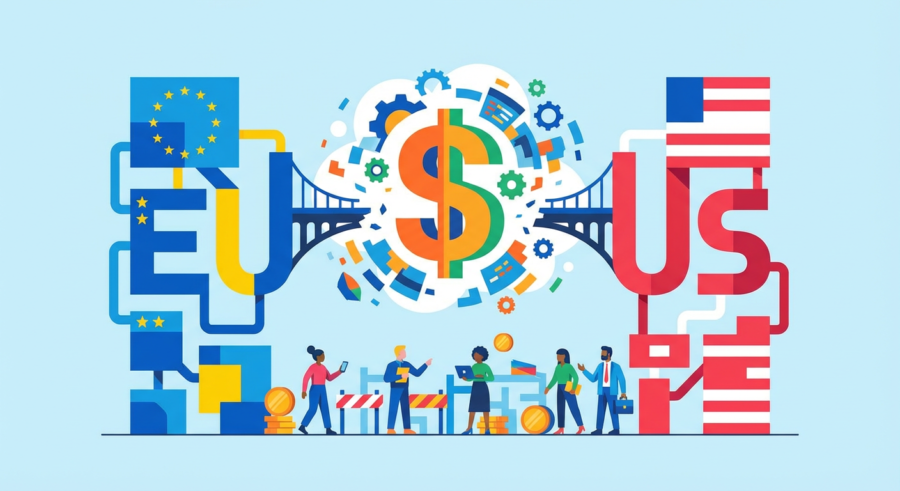
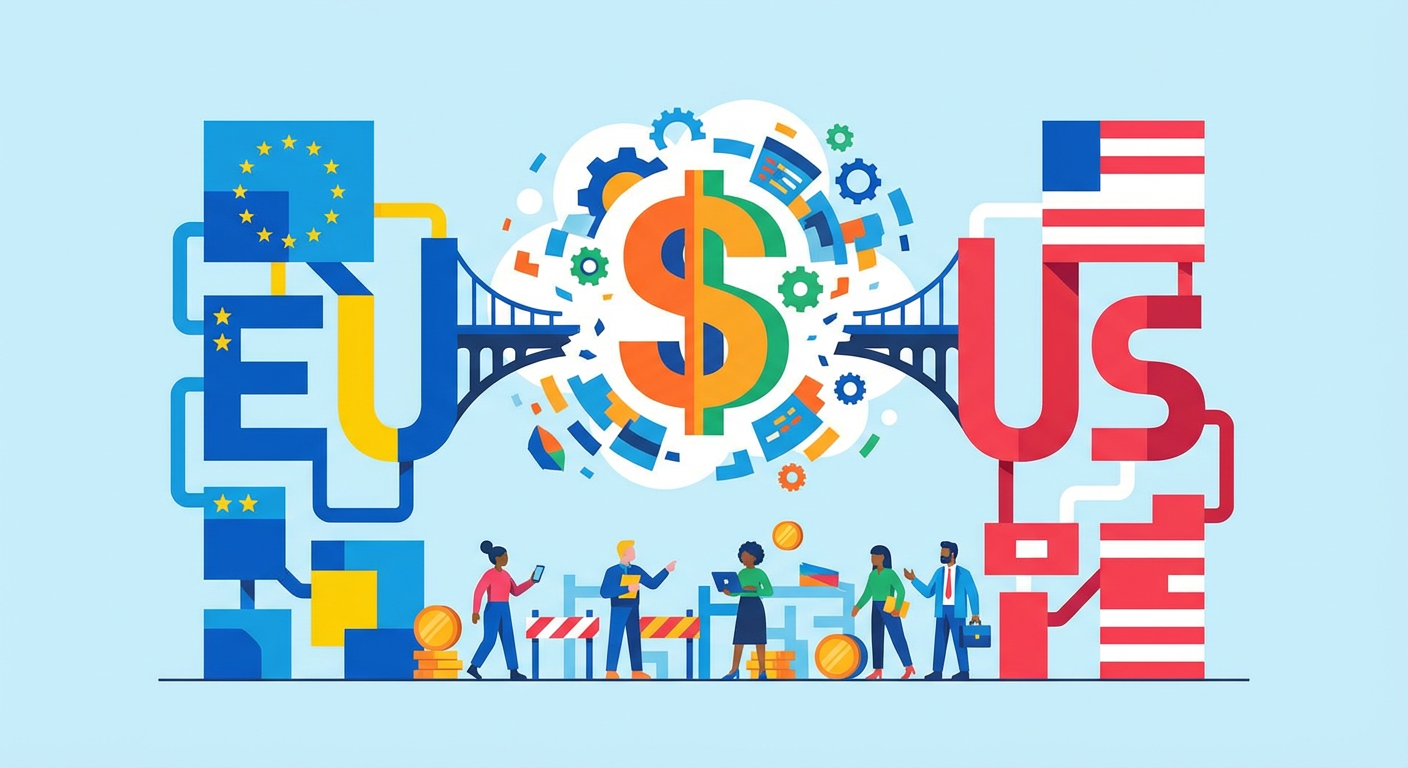
The AI Governance Divide: How the EU's 2025 Enforcement is Splintering Global Tech Regulation
The AI Governance Divide: How the EU’s 2025 Enforcement is Splintering Global Tech Regulation

The Trump administration’s January 2025 executive order rescinded the Biden-era AI safety directives that had tried to establish baseline security standards for federal AI procurement and deployment. More significantly, it explicitly instructed federal agencies to prioritize speed of AI deployment over what the order called “unnecessary precautionary constraints.” Read the language carefully. This is not passive deregulation. This is an affirmative push toward a different philosophical framework entirely.

What we are observing is not a temporary disagreement between regulatory philosophies that will eventually harmonize. This is structural divergence. And the question that should occupy your attention is not whether this split matters — it obviously does. The question is what happens when two adjacent markets with deeply incompatible regulatory architectures both claim to be universal standards.

The Compliance Cost Architecture

Let us be precise about the financial mechanics. A Stanford HAI policy brief from October 2025 analyzed the compliance burden for multinational AI developers operating across both jurisdictions. The estimate was stark: $4.2 billion annually in duplicative compliance infrastructure. This is not a rounding error. This is roughly equivalent to the entire annual R&D budget of a mid-tier AI research division.

The granularity matters here. Under the EU framework, developers must maintain separate documentation chains for high-risk systems, conduct third-party risk assessments before deployment, implement post-market monitoring protocols, and maintain audit trails of training data sources. The EU AI Act official text and implementation timeline specifies these requirements with the kind of operational detail that makes compliance specialists either very busy or very frustrated, depending on their disposition.

The U.S. approach, by contrast, emphasizes speed and market-driven iteration. The executive order explicitly tells agencies not to impose pre-deployment review requirements that would “unnecessarily delay” AI system launches. No separate documentation requirements. No mandatory third-party assessment before deployment. The philosophical difference is not subtle: the EU assumes that regulatory friction prevents harm. The U.S. assumes that regulatory friction prevents benefit. Both cannot be simultaneously correct, but both jurisdictions are now acting as though they are.

The Corporate Choreography

Watch what the major AI developers actually did in 2025, and you will see the real-world consequence of this divide. OpenAI, Google DeepMind, and Meta all submitted compliance documentation to the EU AI Office in the third quarter of 2025. They did this because they had no choice. The enforcement mechanism exists. The fines are real.

Simultaneously, and we have documentation of this from Commerce Department meeting logs released under FOIA request, these same companies were lobbying the U.S. government to explicitly resist adopting equivalent standards. The argument was consistent: such requirements would handicap American AI development relative to Chinese competitors and would fragment the global AI market in ways that harm innovation. These are not unreasonable arguments. They are also not being made in a vacuum of market pressure. They are being made by companies that must now maintain two separate operational architectures.

This is not hypocrisy, precisely. It is something more interesting: rational corporate behavior in an irrational regulatory environment. If you must comply with the EU standard to access European markets, you will comply. If your home market offers deregulatory incentives, you will pursue those. The problem is that this creates incentive structures no individual company can solve through unilateral action. It is a collective action problem dressed in corporate compliance documentation.

The Three-Way Fracture

But the EU-U.S. divide is not the complete picture. China’s Cyberspace Administration finalized its second round of generative AI regulations in mid-2025. These regulations represent a third regulatory architecture, oriented toward neither precautionary restriction nor deployment speed, but toward state capacity and content control. The OECD, in a September 2025 assessment, described the resulting situation as “the most consequential splintering of technology governance norms since GDPR.”

Think about what this means operationally. An AI company operating globally must now maintain three separate compliance regimes. The EU requires technical auditing and pre-deployment assessment. The U.S. encourages rapid deployment with lighter ex-post oversight. China requires demonstration of state alignment and content screening capability. These are not variations on a theme. These are competing architectures with incompatible underlying assumptions about what AI governance should accomplish.

The Stanford HAI AI Index and policy briefs have documented in detail how this fragmentation is now beginning to affect innovation geography. Smaller AI companies, unable to absorb the compliance costs of three separate regulatory regimes, are concentrating their development in single jurisdictions. This is not what a functioning global tech ecosystem looks like. This is what consolidation and fragmentation look like simultaneously.

The Structural Question Ahead

The question that policy makers, investors, and tech leaders should be asking is not whether this divergence can be resolved through diplomatic negotiation in the next few years. The structural incentives are too deeply embedded. The real question is whether the divergence will stabilize into a predictable, manageable pattern or generate cascading effects that make the entire global AI landscape unpredictable.

There are scenarios in which this works. Jurisdictional regulatory arbitrage has existed in other technology domains — financial regulation, pharmaceutical approval, data protection standards. In some cases, companies and regulators developed working solutions. In other cases, the result was regulatory collapse or dangerous gaps.

The distinguishing variable is whether there exists some shared commitment to baseline interoperability and mutual recognition, even among competitors. The evidence from 2025 suggests that commitment may be weakening, not strengthening. When major tech companies simultaneously lobby their home governments to resist harmonization with regulatory competitors while complying with those competitors’ standards in practice, you are observing a system that is fundamentally unstable.

What specific indicators do you think should tell us whether this regulatory fragmentation is stabilizing into manageable forms or destabilizing into something more chaotic? The answer to that question will likely determine the shape of the AI ecosystem for the next decade.

The AI Governance Divide: How the EU AI Act’s Full Implementation in 2025-2026 Is Fracturing Transatlantic Tech Regulation

The Regulatory Divergence Problem

Something genuinely consequential is unfolding across the Atlantic, and it’s getting almost no attention. The EU’s AI Act obligations for high-risk systems entered full force in August 2025, backed by fines up to 35 million euros or 7% of global annual turnover, whichever is higher. At the same time, the Trump administration rescinded Biden-era AI safety directives through executive order in January 2025, explicitly prioritizing deployment speed over precautionary regulation. These moves represent fundamentally incompatible philosophies about how democracies should manage transformative technology, and they’re creating real operational friction for companies caught between them.

The stakes are real precisely because we’ve been here before. When the EU implemented GDPR in 2018, the international technology sector absorbed significant compliance costs but eventually developed operational structures to manage dual-standard requirements. AI governance is a harder problem. Data protection is a mature regulatory domain with well-established legal precedent. AI governance is still experimental. Different regulatory frameworks aren’t merely imposing different standards on the same underlying technology—they’re built on different assumptions about what the technology fundamentally is and what governments can or should do about it.

Understanding this divergence means getting past the lazy framing that the EU prefers “regulation” while America prefers “innovation.” That obscures more than it clarifies. The actual disagreement runs deeper, touching questions about burden of proof, the nature of technological risk, who bears responsibility for harm, and whether government should pre-emptively restrict capabilities or respond after problems emerge. These aren’t questions with empirically correct answers. They’re political choices embedded in different democratic traditions.

The Compliance Architecture Clash

Look at what actually happened in the third quarter of 2025. OpenAI, Google DeepMind, and Meta all submitted formal compliance documentation to the EU AI Office in response to the Act’s high-risk system requirements. The same companies, during the same period, were lobbying the U.S. Commerce Department to resist adopting equivalent standards. This isn’t hypocrisy—it’s rational corporate behavior responding to different legal environments. But the pattern reveals something structurally important about how divergent regulation works in practice.

The EU framework requires developers of high-risk AI systems to conduct documented risk assessments before deployment, maintain detailed records throughout the system’s operational life, establish human oversight mechanisms, and submit to periodic audits by accredited third parties. These requirements impose genuine operational costs. A Stanford HAI policy brief released in October 2025 estimated that regulatory divergence between EU and U.S. frameworks generates roughly 4.2 billion dollars annually in compliance expenses for multinational AI developers. That figure includes duplicate compliance infrastructure, separate documentation systems, and the substantial legal expertise required to navigate both regimes.

What makes this particularly significant isn’t just the cost—it’s the incentive structure it creates. When compliance is expensive and fragmented, larger companies with robust legal and compliance divisions absorb those costs far more easily than smaller competitors. The effect, counterintuitively, may be to entrench market concentration rather than encourage competition. A startup operating in both markets faces proportionally higher compliance burdens than Microsoft or Google. Neither regulatory regime explicitly addresses this market-distortion risk, which strikes me as a serious oversight.

The Three-Way Fragmentation

The situation gets messier when you factor in the third major regulatory power. China’s Cyberspace Administration finalized its second round of generative AI regulations in mid-2025, establishing a third distinct governance framework operating according to its own logic and priorities. These aren’t marginal players. Between them, the EU, United States, and China represent the overwhelming majority of global AI development capacity and nearly all the cutting-edge research institutions capable of producing frontier AI systems.

The OECD characterized this moment in 2025 as “the most consequential splintering of technology governance norms since GDPR.” That framing captures something real, even if it treats fragmentation as settled fact rather than a problem to solve. With GDPR, there was at least a unifying principle—data subjects have rights that companies must respect. The current AI governance landscape lacks even that degree of conceptual coherence. The EU’s framework emphasizes pre-deployment risk management and human oversight. The American approach emphasizes post-deployment transparency and user redress. The Chinese framework emphasizes security and social stability. These aren’t different points along a shared axis. They’re genuinely different conceptions of what AI governance is supposed to accomplish.

The practical consequence is that developers must now design, deploy, and operate AI systems according to potentially contradictory requirements. A content moderation system acceptable under EU risk assessment requirements might violate American First Amendment principles or Chinese sovereignty requirements. These aren’t trivial incompatibilities. They require either abandoning certain markets, maintaining separate product versions, or making substantive compromises to core system design.

What the Evidence Actually Shows

We should be careful about overconfident predictions regarding which regulatory model will “win” or whether convergence remains possible. History suggests that network effects and market power typically drive technical standards toward a dominant model, but governance standards operate differently. The EU AI Act is already law with enforcement mechanisms in place. The American regulatory framework, by contrast, remains scattered across multiple agencies with no comprehensive statutory foundation. The Chinese system consists of state directives issued through administrative channels. These aren’t equivalent structures operating on equivalent timelines.

What the Stanford HAI AI Index and policy briefs actually document isn’t a prediction about which model will dominate—it’s a measurement of current compliance costs and market impacts. That data shows real economic friction is already here. Companies report longer time-to-market for AI products in certain jurisdictions, strategic decisions to prioritize specific geographic markets, and increased legal and compliance staffing. These are observable facts, not speculative projections.

The evidence also suggests that regulatory convergence isn’t currently happening, despite the stated preference for harmonization from multiple international organizations. Neither the EU nor the U.S. has shown willingness to substantially modify its approach. China’s framework keeps evolving according to its own strategic priorities. If convergence were actually happening, we’d expect harmonization proposals to be gaining serious traction at the policy level. The absence of that movement suggests each jurisdiction views its approach as reflecting legitimate national values, not as a temporary position awaiting alignment.

The Deeper Question About Democratic Governance

What ultimately matters about this regulatory divergence isn’t just the operational complexity it creates for technology companies, though that’s real. What matters is what it reveals about how democracies approach collective decisions about transformative technology in an interconnected world. The EU chose to move first with comprehensive legislation built on precautionary principles. The U.S. proceeded through distributed sectoral regulation coupled with speed prioritization. Both choices reflected legitimate democratic values and constituency preferences. Neither was objectively wrong.

The problem is that both choices assume regulatory authority at the national or supranational level can meaningfully constrain technology that operates globally. That assumption may not hold. If AI development concentrates in jurisdictions with lighter regulatory frameworks, and if the systems produced there become de facto global standards through network effects and market penetration, then strict regulation elsewhere may constrain only domestic companies and innovation—not the technology itself. This is the genuine dilemma facing policymakers, and it has no purely technical solution.

The fragmentation we’re watching in 2025 and 2026 will likely reshape how we think about technology governance more broadly. If regulatory divergence produces inferior outcomes for everyone—higher compliance costs, market distortion, persistent governance gaps—it may eventually push toward either genuine harmonization efforts or toward accepting that some technological domains simply aren’t amenable to meaningful regulation through existing state structures. Neither option is comfortable, but both are at least intellectually honest responses to what the evidence is telling us. What interpretations of this moment do you find most persuasive? What governance models do you think better balance innovation, safety, and democratic legitimacy?

The AI Dungeon Master Debate: How Generative NPCs Are Splitting the Gaming Community in 2025

Before diving into the specifics, it’s worth establishing why this particular development sits at an intersection that politics audiences — more than most — are positioned to understand.

The AI Dungeon Master Debate: How Generative NPCs Are Splitting the Gaming Community in 2025

A Fresh Set of Eyes on a Rapidly Changing Landscape

I came to gacha gaming later than most, which gives me the advantage of seeing the current landscape without the nostalgia goggles that longtime players sometimes wear. The same clarity applies when I look at what is happening to NPCs in 2025. Generative AI has moved from a tech demo curiosity into actual shipped products, and the gaming community is not quietly accepting the change. It is arguing loudly about it, and the argument reveals something important about what players actually want from the worlds developers build for them.

The context shapes everything. The evidence here is worth examining carefully. Starting with that context makes the rest land harder.

The debate is not simply about technology. It is about authorship, about labor, and about whether a conversation with a virtual character means anything if no human being wrote those specific words. Those are not small questions. They touch on why people play games in the first place, and the answers vary wildly depending on who you ask.

From Tech Demo to Live Game: The Ubisoft Experiment

Ubisoft was among the first major publishers to show the industry where this was heading. Their Ubisoft NEO NPC Technology Overview outlined a system capable of generating fully voiced, contextually responsive dialogue for in-game characters, and the studio demonstrated early versions of it back in 2023. What felt speculative then became reality in 2025, when the technology rolled out at meaningful scale inside post-launch content updates for Assassin’s Creed Shadows. Select NPCs in the game could now hold conversations that no writer had scripted word for word, responding dynamically to player input with synthesized voices.

The reception was genuinely mixed. Some players found the experience revelatory, describing conversations with minor characters that felt surprisingly natural and contextually aware. Others found it alienating, sensing something hollow beneath the fluency. That split reaction is not anecdotal. A 2025 Nielsen Games Consumer Survey found that among players between 18 and 34, slightly more than half said AI-driven NPC dialogue made their experience feel more immersive. But a substantial 38 percent described the interactions as uncanny or emotionally empty compared to dialogue crafted by human writers. Both groups are right about their own experiences, which is exactly what makes this debate so hard to resolve.

The Shadows deployment also raised a structural question the industry has not yet answered cleanly. When an NPC can say almost anything, who is responsible for what it says? Moderation, consistency, and narrative coherence all become harder problems. A scripted character cannot go off-brand. A generative one can, and in a world where games are live services updated over months and years, that unpredictability carries real risk.

The Labor Question Refuses to Stay Quiet

Every conversation about AI in games eventually arrives at the same uncomfortable intersection: the people whose work is being automated or supplemented did not necessarily agree to that arrangement. The Writers Guild of America negotiated specific AI provisions into their 2023 contract after a bruising strike, and those provisions were written with exactly this kind of deployment in mind. The agreement offered some protections, but the boundaries of those protections became contested again in 2025 when Insomniac Games disclosed that a post-launch patch for Spider-Man 2 had used AI voice synthesis to generate lines for background NPCs.

The disclosure itself was notable. Insomniac chose transparency rather than silence, which at minimum reflects an awareness that concealment carries its own reputational cost. But voice actors and writers pushed back on the substance, arguing that even background lines represent work that belongs to human performers and should be compensated as such. The WGA provisions from 2023 became a reference point in that argument, though whether they applied cleanly to the specific case remained disputed. The episode illustrated that labor agreements negotiated before a technology matures at scale will almost always have gaps, and those gaps tend to be discovered by the workers with the least leverage.

Background NPCs have historically been treated as the lowest-priority creative work in game development, the ambient chatter that fills a world without advancing it. Framing AI use as limited to that category is a deliberate choice, and critics argue it is also a foot in the door. If synthesis is acceptable for throwaway lines today, the boundary between background and foreground can shift quietly over time.

Platform-Level Pressure and the Push for Transparency

The industry did not just absorb these tensions passively. Pressure from players and advocates pushed platform holders to respond in ways that would have seemed premature even eighteen months earlier. Steam added a dedicated disclosure tag for AI-generated content to its storefront in early 2025, following sustained community pressure on Valve to make the distinction visible at the point of purchase. By the end of the year, more than 1,200 games carried that tag according to Valve’s own transparency reporting. You can explore how that system works through the Steam AI Content Policy and Disclosure Page, which shows how quickly disclosure has moved from a fringe request to an expected standard.

Microsoft took a different approach at the publisher level. Xbox Game Studios released an internal AI ethics framework in mid-2025 that committed the company to labeling any AI-generated content appearing in first-party titles. The framework was notable for existing in public at all, since most studios treat internal guidelines as proprietary. Whether the commitment holds as competitive pressure intensifies is a question worth watching, but publishing it creates a form of accountability that secrecy would not.

Together, these moves signal that the era of slipping AI content into games without acknowledgment is narrowing. Players who care about the distinction now have better tools to act on that preference. The debate has moved, at least partially, from whether disclosure should happen to how it should be structured and enforced.

Where the Community Goes From Here

The split inside the gaming community over generative NPCs is unlikely to close soon, because it reflects genuinely different values rather than different amounts of information. Players who prioritize reactive, expansive worlds are finding real value in systems that can populate those worlds with something beyond canned repetition. Players who came to games because of the craft embedded in every line of dialogue are finding that the same systems strip out something they considered essential.

Both groups are describing the same technology accurately. That is what makes this moment genuinely complicated rather than simply controversial. The industry is being asked to hold two truths at once: that generative AI can make certain experiences richer, and that the way it is deployed can cause real harm to the people who built the craft it is now partially replacing. Finding frameworks that honor both realities is slower and harder than picking a side, but it is the only approach that leads somewhere sustainable.

The dungeon master metaphor that players and critics keep reaching for is telling. A good dungeon master is not just generating plausible responses. They are making meaningful choices shaped by empathy, experience, and care for the people at the table. Whether an AI system can ever replicate that, or whether it even needs to, may be the question the gaming community is really arguing about when it argues about NPCs.

If the intersection of gaming culture, mobile entertainment, and industry analysis is on your radar, metatrend.app connects individual stories to larger patterns consistently.

Understanding the mechanism matters as much as knowing the outcome. Follow the full thread for sourced breakdowns.

The AI Governance Fork in the Road: What Europe’s Strict Rules Mean When America Steps Back

Two Visions Diverge, and the Gap Widens

The disconnect between European and American approaches to artificial intelligence regulation has moved beyond philosophical disagreement into material reality. Starting in August 2025, the European Union began enforcing the high-risk provisions of its AI Act, a regulatory framework that treats certain AI applications the way financial regulators treat derivatives or pharmaceutical agencies treat novel drugs. At the same time, the incoming Trump administration in January 2025 rescinded the previous administration’s October 2023 Executive Order on AI Safety, signaling a fundamentally different bet about how innovation and safety should be balanced. This isn’t merely a transatlantic disagreement anymore. It’s a fork in the road with real consequences for how AI gets deployed, who bears responsibility when things go wrong, and ultimately which regulatory model will influence the next wave of AI development globally.

The AI Governance Fork in the Road: What Europe's Strict Rules Mean When America Steps Back
The AI Governance Fork in the Road: What Europe’s Strict Rules Mean When America Steps Back

Understanding this divergence requires resisting the temptation to treat it as simple ideological conflict between innovation-friendly Americans and precaution-minded Europeans. The actual picture is more complicated. The EU’s approach reflects decades of experience with product safety regulation, data protection battles, and antitrust enforcement in tech markets. The American deregulatory move reflects genuine concerns about losing technological advantage to China and frustration with what some call regulatory overreach. Both positions contain defensible arguments. Both also contain risks that their proponents don’t fully account for.

What makes this moment significant is that we’re no longer debating regulatory philosophy in the abstract. We’re watching two different systems actually attempt to govern the same technology. That collision is already producing effects that ripple far beyond boardrooms and government offices.

What the EU Actually Requires, and Why It Matters Locally

The EU AI Act’s high-risk classification covers AI systems deployed in employment, education, and critical infrastructure. This means that if a company uses AI to screen job applications, evaluate student performance, or manage power grids, it now operates under a specific regulatory regime. The conformity assessments are not theoretical exercises. They require documented proof that the system has been tested, that it performs according to specifications, and that humans can intervene when necessary. Companies must maintain transparency documentation showing how the AI makes decisions, and they must establish human oversight mechanisms so that no critical decision happens without someone actually reviewing it.

For organizations in Europe, this has meant redirecting internal resources toward compliance infrastructure. Hiring or contracting for expertise in AI auditing, documentation, and governance. Slowing down deployment timelines. A hospital deploying an AI system for radiology screening in 2025 faces compliance requirements that didn’t exist in 2024. A logistics company implementing automated hiring must build in human review processes, even when those processes feel cumbersome compared to fully automated alternatives. This isn’t abstract policy talk. It’s real people spending real time on documentation instead of feature development.

The EU AI Office, established in 2024 to oversee this framework’s implementation, has already logged over 200 formal complaints in its first operational year. Most relate to general-purpose AI model providers, the companies that build the large language models and foundational models underpinning dozens of downstream applications. The complaints range from questions about what counts as high-risk to disputes over compliance deadlines to accusations that certain systems shouldn’t have been approved for high-risk deployment. That volume in year one suggests the regulatory regime is doing what it’s designed to do: create friction, require justification, demand accountability.

America’s Regulatory Retreat and What It Signals

The Trump administration’s January 2025 rescission of the Biden-era AI Executive Order represents a deliberate step backward from federal safety governance. That previous order had required federal safety reporting for frontier AI models. It had directed agencies to conduct risk assessments before deploying AI in consequential decisions. It had signaled that the federal government viewed AI safety as a legitimate regulatory concern, not merely a competitive disadvantage.

The new directive reframes the question entirely. Agencies are now instructed to prioritize AI competitiveness over precautionary regulation. Safety concerns are framed implicitly as obstacles to innovation rather than prerequisites for responsible deployment. This doesn’t mean safety is ignored entirely. It means the regulatory burden, what exists of it, shifts toward voluntary industry compliance and state-level initiatives rather than federal standards.

The practical effect is that an American company can move faster, cheaper, and with less compliance overhead than its European counterparts. That’s the intended consequence, and it’s genuine. A startup in San Francisco building an AI recruiting tool can iterate more rapidly than a competitor in Stuttgart, who must satisfy EU conformity assessment requirements. This competitive advantage is real, measurable, and deliberate.

The Global Stakes: Who Sets the Norm?

Here’s where the geopolitical dimension becomes unavoidable. According to the Stanford HAI Artificial Intelligence Index Report, the United States and China together accounted for over 70% of significant AI model releases in 2024. That concentration of capability is staggering. It means that whatever approach America and China ultimately settle on will disproportionately shape how AI development proceeds globally, regardless of what Brussels mandates. If neither Beijing nor Washington feels constrained, European rules become primarily a tax on European companies operating in European markets, not a global standard.

China’s own approach complicates this picture further. The Cyberspace Administration issued its third major generative AI regulatory update in 2025, maintaining its system of mandatory algorithm registration while approving hundreds of domestic large language model deployments for public use. This is something different from both the European and American models. It’s regulatory oversight yoked explicitly to national security and state control rather than consumer protection or innovation facilitation. Heavy-handed governance that nonetheless permits rapid domestic deployment once approval is granted.

The question facing policymakers in Brussels, Washington, and beyond is whether regulatory fragmentation ultimately weakens AI governance globally or merely compartmentalizes it. If American companies can avoid EU-style scrutiny by deploying primarily in US markets and to non-EU customers, does European regulation actually influence global norms? Or does it primarily disadvantage European competitors while leaving the core question of how AI gets governed globally effectively unresolved?

Local Reality: Where This Plays Out

Consider how a healthcare system in a mid-sized American city actually experiences this governance gap. A hospital in Ohio exploring AI-powered diagnostic tools faces minimal federal barriers to implementation. Compliance means navigating FDA guidance if the tool makes clinical recommendations, but the bar is substantially lower than what a hospital in Frankfurt faces under the EU AI Act. The American hospital can deploy faster, cheaper, with less documentation overhead. That seems clearly advantageous until the moment something goes wrong.

When an AI-recommended treatment contributes to a patient harm, liability questions emerge. The American hospital can point to the absence of specific federal AI regulations as partial cover. The Frankfurt hospital faces both regulatory scrutiny and liability exposure, but also has documentation, testing records, and human oversight mechanisms already in place that might actually help defend against negligence accusations. Which system protects patients better? Which holds organizations more accountable? The answer probably depends on the specific failure mode, and neither system has perfect answers.

This is precisely why the global governance gap matters at the local level. It doesn’t just affect corporate competitiveness or national prestige. It shapes how technologies actually get developed, tested, and deployed in the communities where people live and work. A governance vacuum in America doesn’t mean safer or faster innovation. It means innovation that proceeds with different assumptions about who bears responsibility when outcomes diverge from expectations. Different assumptions lead to different systems, which ultimately means different outcomes for the people those systems affect.

The path forward isn’t obvious. The EU’s approach may slow innovation while providing stronger accountability mechanisms. The American approach may accelerate development while leaving questions of responsibility ambiguous. China’s approach prioritizes state control above both innovation speed and consumer protection. Readers interested in tracking how these frameworks are actually being implemented can consult the EU AI Act Official Text and Implementation Timeline and the latest Stanford HAI Artificial Intelligence Index Report for concrete data on deployment patterns and compliance trends. What aspects of this governance divergence concern you most in your own community or professional context? How we govern powerful technologies doesn’t resolve itself through policy alone. It requires ongoing engagement with the specific tradeoffs these frameworks create.

Page 9 of 15