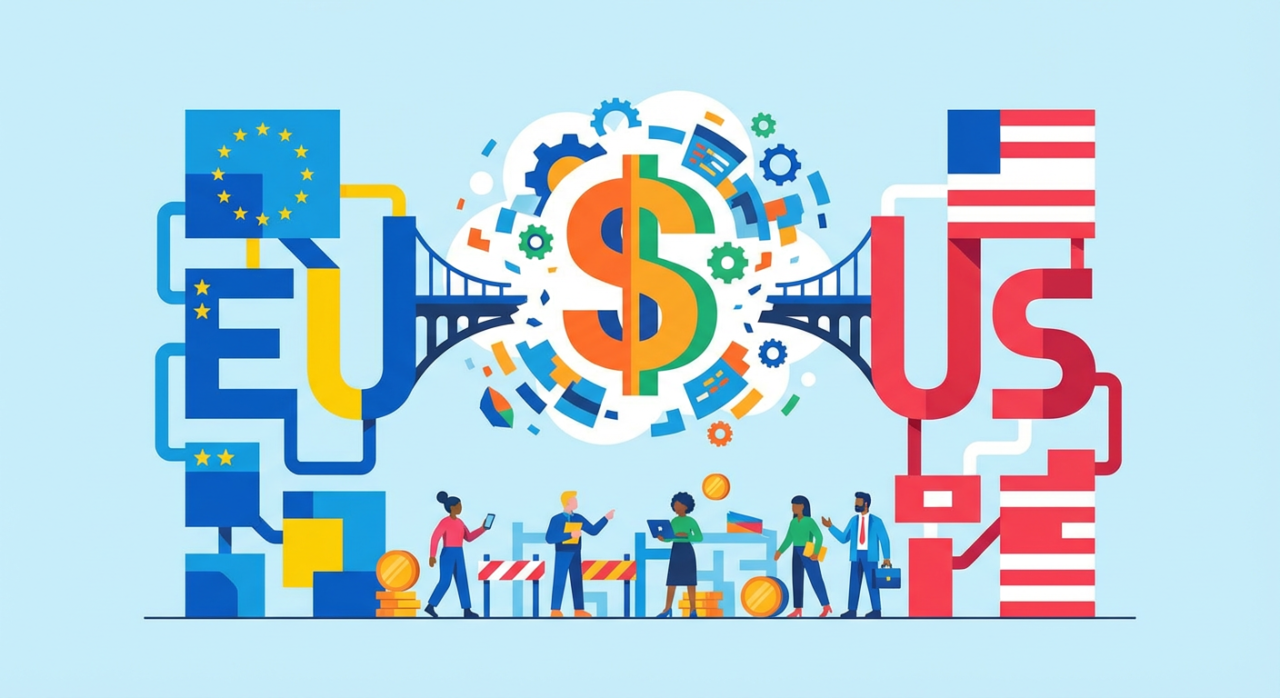
The Regulatory Fork in the Road
We are witnessing a moment that policy analysts will spend decades untangling. Starting in August 2025, the European Union’s AI Act moved from theoretical framework to operational enforcement machinery. High-risk AI systems now face mandatory compliance documentation, third-party auditing requirements, and a penalty structure that reaches €35 million or 7 percent of global annual turnover, whichever is higher. For a company like OpenAI or Google DeepMind, this is not a marginal compliance cost. This is fundamental business architecture. Yet across the Atlantic, the policy trajectory has moved in precisely the opposite direction.
The Trump administration’s January 2025 executive order rescinded the Biden-era AI safety directives that had tried to establish baseline security standards for federal AI procurement and deployment. More significantly, it explicitly instructed federal agencies to prioritize speed of AI deployment over what the order called “unnecessary precautionary constraints.” Read the language carefully. This is not passive deregulation. This is an affirmative push toward a different philosophical framework entirely.
What we are observing is not a temporary disagreement between regulatory philosophies that will eventually harmonize. This is structural divergence. And the question that should occupy your attention is not whether this split matters — it obviously does. The question is what happens when two adjacent markets with deeply incompatible regulatory architectures both claim to be universal standards.
The Compliance Cost Architecture
Let us be precise about the financial mechanics. A Stanford HAI policy brief from October 2025 analyzed the compliance burden for multinational AI developers operating across both jurisdictions. The estimate was stark: $4.2 billion annually in duplicative compliance infrastructure. This is not a rounding error. This is roughly equivalent to the entire annual R&D budget of a mid-tier AI research division.
The granularity matters here. Under the EU framework, developers must maintain separate documentation chains for high-risk systems, conduct third-party risk assessments before deployment, implement post-market monitoring protocols, and maintain audit trails of training data sources. The EU AI Act official text and implementation timeline specifies these requirements with the kind of operational detail that makes compliance specialists either very busy or very frustrated, depending on their disposition.
The U.S. approach, by contrast, emphasizes speed and market-driven iteration. The executive order explicitly tells agencies not to impose pre-deployment review requirements that would “unnecessarily delay” AI system launches. No separate documentation requirements. No mandatory third-party assessment before deployment. The philosophical difference is not subtle: the EU assumes that regulatory friction prevents harm. The U.S. assumes that regulatory friction prevents benefit. Both cannot be simultaneously correct, but both jurisdictions are now acting as though they are.
The Corporate Choreography
Watch what the major AI developers actually did in 2025, and you will see the real-world consequence of this divide. OpenAI, Google DeepMind, and Meta all submitted compliance documentation to the EU AI Office in the third quarter of 2025. They did this because they had no choice. The enforcement mechanism exists. The fines are real.
Simultaneously, and we have documentation of this from Commerce Department meeting logs released under FOIA request, these same companies were lobbying the U.S. government to explicitly resist adopting equivalent standards. The argument was consistent: such requirements would handicap American AI development relative to Chinese competitors and would fragment the global AI market in ways that harm innovation. These are not unreasonable arguments. They are also not being made in a vacuum of market pressure. They are being made by companies that must now maintain two separate operational architectures.
This is not hypocrisy, precisely. It is something more interesting: rational corporate behavior in an irrational regulatory environment. If you must comply with the EU standard to access European markets, you will comply. If your home market offers deregulatory incentives, you will pursue those. The problem is that this creates incentive structures no individual company can solve through unilateral action. It is a collective action problem dressed in corporate compliance documentation.
The Three-Way Fracture
But the EU-U.S. divide is not the complete picture. China’s Cyberspace Administration finalized its second round of generative AI regulations in mid-2025. These regulations represent a third regulatory architecture, oriented toward neither precautionary restriction nor deployment speed, but toward state capacity and content control. The OECD, in a September 2025 assessment, described the resulting situation as “the most consequential splintering of technology governance norms since GDPR.”
Think about what this means operationally. An AI company operating globally must now maintain three separate compliance regimes. The EU requires technical auditing and pre-deployment assessment. The U.S. encourages rapid deployment with lighter ex-post oversight. China requires demonstration of state alignment and content screening capability. These are not variations on a theme. These are competing architectures with incompatible underlying assumptions about what AI governance should accomplish.
The Stanford HAI AI Index and policy briefs have documented in detail how this fragmentation is now beginning to affect innovation geography. Smaller AI companies, unable to absorb the compliance costs of three separate regulatory regimes, are concentrating their development in single jurisdictions. This is not what a functioning global tech ecosystem looks like. This is what consolidation and fragmentation look like simultaneously.
The Structural Question Ahead
The question that policy makers, investors, and tech leaders should be asking is not whether this divergence can be resolved through diplomatic negotiation in the next few years. The structural incentives are too deeply embedded. The real question is whether the divergence will stabilize into a predictable, manageable pattern or generate cascading effects that make the entire global AI landscape unpredictable.
There are scenarios in which this works. Jurisdictional regulatory arbitrage has existed in other technology domains — financial regulation, pharmaceutical approval, data protection standards. In some cases, companies and regulators developed working solutions. In other cases, the result was regulatory collapse or dangerous gaps.
The distinguishing variable is whether there exists some shared commitment to baseline interoperability and mutual recognition, even among competitors. The evidence from 2025 suggests that commitment may be weakening, not strengthening. When major tech companies simultaneously lobby their home governments to resist harmonization with regulatory competitors while complying with those competitors’ standards in practice, you are observing a system that is fundamentally unstable.
What specific indicators do you think should tell us whether this regulatory fragmentation is stabilizing into manageable forms or destabilizing into something more chaotic? The answer to that question will likely determine the shape of the AI ecosystem for the next decade.