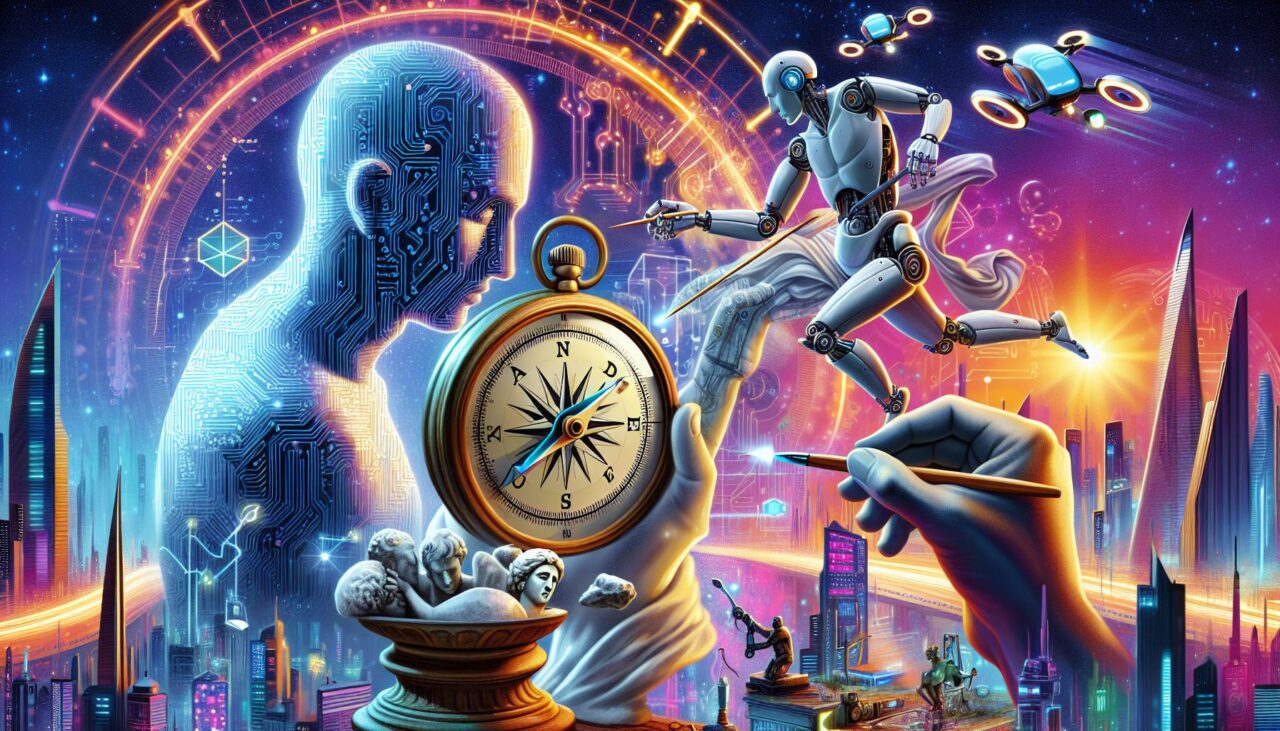
Hello fellow future-dwellers! Today, we’re diving into one of my favorite rabbit holes: the colorful and mind-bending intersection of Artificial Intelligence and the creative arts. Now, before you roll your eyes at yet another techie love letter to AI, hear me out. This isn’t your typical doomsday “robots are taking over” narrative. Nope, this is something that genuinely gets me excited because it speaks to the core of what makes us human, our creativity, and how AI might just be the turbo-boost it needs.
AI in Creative Arts: Not Just a Hype Train
When AI first started dipping its toes into creative waters, the results were… let’s say, mixed. I remember trying out some of the early computer-generated art programs that churned out pieces which looked like something my cat barfed up. But fast forward a few years, and holy smokes! We’ve come a long way. These days, AI-generated art can be genuinely impressive. Companies like OpenAI and DeepMind have pushed things forward, developing models that produce works of art that don’t just impress but actually inspire.
The Art of AI Art
Let’s kick things off with some mind-blowing developments. One of the standout examples is DALL-E, a neural network that generates detailed images from just a simple textual description. If you told me a few years ago that such precise creativity could spring from the binary mind of a machine, I’d have laughed my head off.
So, what can AI bring to the realm of art that’s genuinely new? For starters, it can explore creative boundaries without the hang-ups of human biases. It brings a fresh eye to age-old questions about the nature of aesthetics. Take AI-generated music. These algorithms can examine millions of compositions and not just mimic them, but synthesize entirely new genres that push musical boundaries.
Artists & Algorithms: Partners in Creation
Is AI replacing artists? Absolutely not. Think of AI as an incredibly smart paintbrush or a musically gifted computer keyboard. Just as an artist isn’t diminished by picking up a new tool, engaging with AI can open new avenues for human creativity. Artists like Mario Klingemann and Refik Anadol are literally changing the way we experience art, blending human intuition with machine intelligence to create immersive experiences. This isn’t man versus machine. It’s man and machine.
Challenges in the AI-Art Arena
Alright, before I sound too much like a starry-eyed AI fan club president, let’s get real about some of the challenges facing AI in the creative arts.
Whose Art is it Anyway?
First up is the gnarly problem of authorship and ownership. If an AI creates a masterpiece, who actually owns it? The coder who wrote the algorithm? The machine itself? This brings up all sorts of legal and ethical questions that need untangling, often sparking heated debates in art and tech circles.
The Bias Bug
Just like any software, AI can inherit biases from its human creators if it’s not carefully supervised. There have been instances where AI-generated art accidentally reflected societal prejudices. This isn’t the kind of repeat performance we want from our tech. Building a bridge between AI’s raw potential and ethically responsible creativity is necessary.
Future Outlook: A Cybernetic Renaissance?
Peeking into the crystal ball of speculation, one can imagine a future where AI doesn’t just participate in the arts but triggers a new Renaissance, one defined by unprecedented collaboration between human intuition and machine intelligence.
Cross-Disciplinary Collaborations
Imagine AI working alongside architects to visualize and create mind-bending structures that seem straight out of a sci-fi novel. Picture collaboratively written novels, where AI helps craft plot lines and develop characters that resonate deeply with readers. We could see screenplays co-created by AI, visual storyboarding done in real-time, and emotionally aware music scores that adapt to the mood they’re supposed to accompany. Sounds crazy? Maybe. But so did the internet a few decades back!
Conclusion: Embracing the Unpredictable
As AI continues to advance, one thing’s clear: We have a lot to look forward to. This isn’t a threat to creativity, nor is it a passing fad. It’s an evolution, one that could redefine what we know about art and potentially expand our horizons beyond anything we’ve dreamed of.
To all my fellow tech-heads and art enthusiasts, let’s embrace the AI revolution with open minds and a sense of wonder. The paint on the digital canvas is still drying, but the masterpiece is well on its way. After all, who knows what a Venn diagram of AI and creativity might yield? If anything, it’s bound to keep us intrigued, puzzled, and excited for what’s next on this creative ride. Stay curious, my friends!