
The Turnout Story Nobody Expected to Write
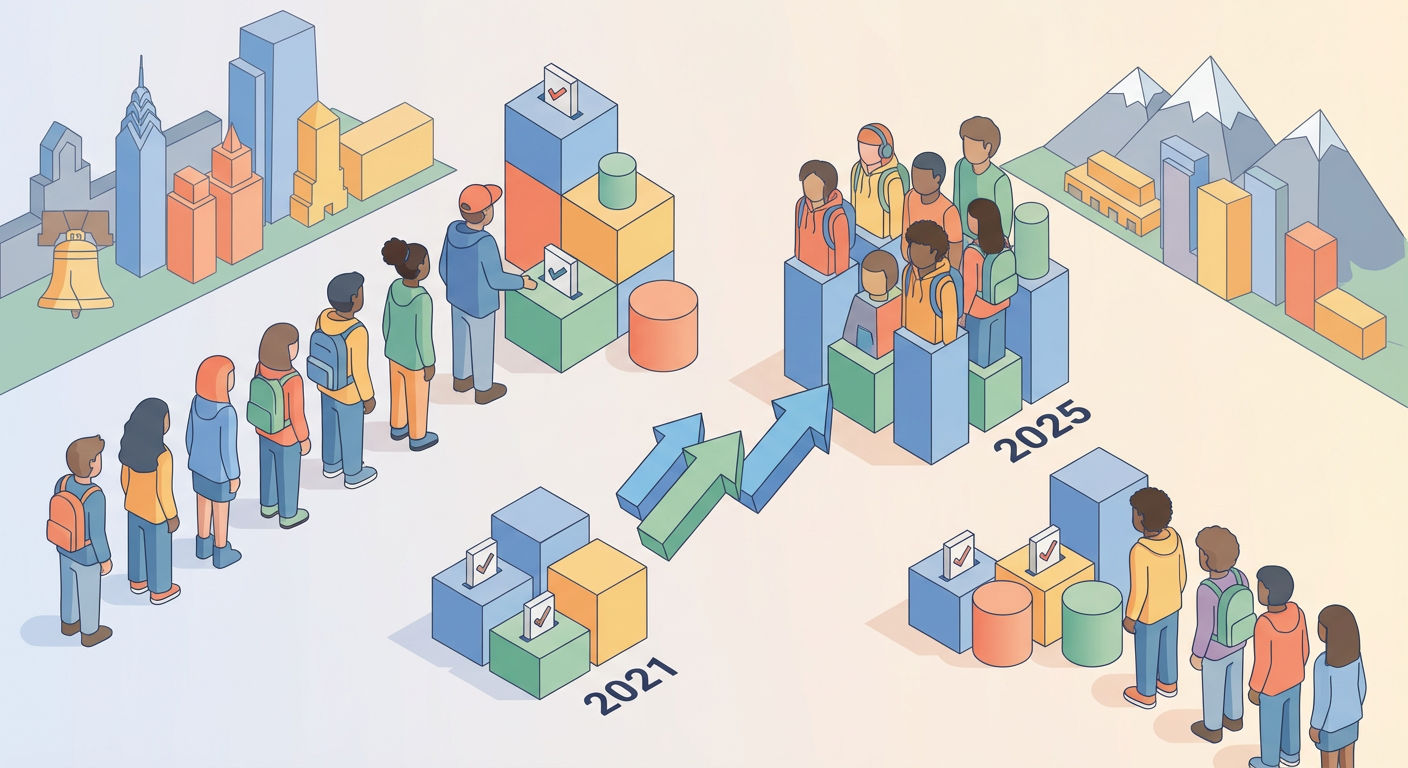
When election analysts looked at the 2025 municipal cycle results, they found themselves confronting a genuinely puzzling phenomenon. Voters aged 18 through 27 showed up in Philadelphia and Denver at rates 12 to 15 percentage points higher than their 2021 equivalents. This matters not because youth turnout is inherently virtuous—that’s a sentiment for greeting cards, not analysis—but because it fundamentally contradicts the narrative that defined American youth political engagement for the past decade. We have spent considerable time documenting the ways younger voters disengage from electoral politics, treating abstinence as a rational response to systems that ignore their material interests. Yet here we are, watching the opposite pattern emerge at precisely the moment when most observers had written off local elections as essentially irrelevant to anyone under 30.

The question deserves more than simple celebration. We must ask what actually changed. Did the political system suddenly become more responsive to younger voters’ concerns, or did younger voters fundamentally alter their assessment of which electoral venues mattered? The answer is neither and both simultaneously, which is precisely why this moment warrants serious intellectual attention. Harvard Youth Poll on Political Engagement research found that 52 percent of Americans aged 18 to 29 now rate local elections as more important than federal contests. That’s a profound reorientation of political priorities, one that conventional turnout analysis can’t fully explain.
Ballot Initiatives as the True Currency of Gen Z Political Power
The real story emerging from 2025 involves a subtle but critical distinction. Gen Z voters did not simply show up in greater numbers; they showed up specifically for ballot initiatives that addressed their material lives. In Austin and Minneapolis, tenant protection measures passed overwhelmingly, driven by under-30 voter coalitions that organized around housing costs rather than traditional campaign apparatus. These were not abstract policy debates conducted in civics classrooms. These were direct democracy instruments that promised tangible consequences for rent, eviction procedures, and tenant rights. The voters who turned out for these measures understood something that political professionals had largely missed: ballot initiatives operate under different rules than candidate elections, and those rules favor grassroots organization more directly.
Consider what happened with ranked choice voting initiatives. Seven new jurisdictions adopted RCV in November 2025, bringing the total number of American jurisdictions using this system to over 60. Now, RCV is not inherently exciting. It is a procedural mechanism. It does not solve inequality or redistribute resources. Yet younger voters supported these measures at substantially higher rates than older cohorts because they understood RCV as addressing something they experienced as concrete: the feeling that their actual preferences were being erased by strategic voting dynamics and two-party constraint. This perception may be technically debatable—FairVote Ranked Choice Voting Implementation Tracker documentation shows RCV’s actual effects vary by context—but the perception itself is real enough to drive turnout. Gen Z voters were not voting on abstract democratic theory. They were voting on their lived experience of political constraint.
The Uncomfortable Truth About Scale and Coalition Building
Here we must pause and acknowledge the tension that makes this moment genuinely complicated. The surge in Gen Z turnout on local ballot initiatives reflects both genuine political awakening and a somewhat troubling insularity. Younger voters have organized effectively around housing, electoral procedure, and tenant protections because these issues directly affect their daily lives. But this hyper-localism, while understandable, also represents a potential fragmentation of political power that could ultimately disadvantage younger voters in aggregate. When political energy concentrates on municipal ballot measures, it fragments across hundreds of jurisdictions with minimal coordination or shared strategic vision.
Vote.org registered 1.2 million new voters aged 18 to 24 in the 12 months preceding November 2025 elections. That is genuinely impressive infrastructure work. But we should ask whether this registration wave translates into sustained political capacity or represents a one-time mobilization around specific ballot questions. The data remain ambiguous. Younger voters showed marked enthusiasm for ballot initiatives that directly affected housing costs and electoral procedure. What remains untested is whether this enthusiasm extends to state-level issues, national party building, or policy domains that require coordinated action across multiple jurisdictions. The pessimistic reading suggests we are watching younger voters discover the importance of local politics precisely at a moment when key decisions about their futures are being made at state and federal levels.
Why Procedural Measures Matter More Than We Admit
Yet the focus on ballot initiatives, particularly on procedural innovations like ranked choice voting, reveals something important that political science has long underestimated. Younger voters are not simply indifferent to process. They recognize, perhaps more acutely than older voters, that procedural rules determine whose preferences actually get counted. This is not naive idealism. It’s sophisticated political analysis from voters who grew up watching YouTube tutorials on strategic voting, gerrymandering mechanics, and campaign finance structures. They understand that you cannot win transformative policy changes if the procedural rules systematically disadvantage your coalition. Hence the enthusiasm for RCV and for ballot initiatives themselves as mechanisms that bypass legislative obstruction.
The housing measures in Austin and Minneapolis fit this pattern. Younger voters did not simply want more tenant protections in abstract. They wanted mechanisms that would create enforceable rights against landlord strategies that had previously seemed unchallengeable. Ballot initiatives promised direct democracy pathways that circumvented city councils or legislatures where landlord influence might be concentrated. This reflects sophisticated political reasoning about institutional constraints and strategic advantage, not naive faith in popular democracy.
Toward a Provisional Conclusion: What 2025 Actually Tells Us
The evidence from the 2025 municipal cycle suggests that Gen Z voters are not abandoning electoral politics. Rather, they are rationally redeploying their limited political energy toward electoral venues where they perceive actual leverage. This redeployment carries both genuine strengths and genuine dangers. On one hand, the surge in younger voter turnout around ballot initiatives demonstrates that disengagement was never inevitable—it reflected rational calculation about where votes mattered. On the other hand, the fragmentation of Gen Z political energy across hundreds of local ballot questions may obscure the degree to which key decisions about their lives are being made elsewhere. Ranked choice voting in 60 American jurisdictions is genuinely significant. But it remains impossible without coordinated state-level action on election law. Tenant protections in Austin and Minneapolis are materially important to younger residents. But they cannot solve the nationwide housing shortage that reflects federal zoning policy, national capital markets, and state-level regulatory frameworks.
What changed between 2021 and 2025 is not that younger voters suddenly became engaged. What changed is that they found electoral venues where engagement seemed strategically rational. Whether that represents a genuine reorientation of political power or a sophisticated distraction remains the question that shapes how we interpret this moment. The answer likely depends on whether this ballot initiative energy can scale into sustained coordination on larger policy questions or whether it fragments further into hyperlocal concerns. I remain genuinely uncertain. I welcome your thoughts on this in the comments.