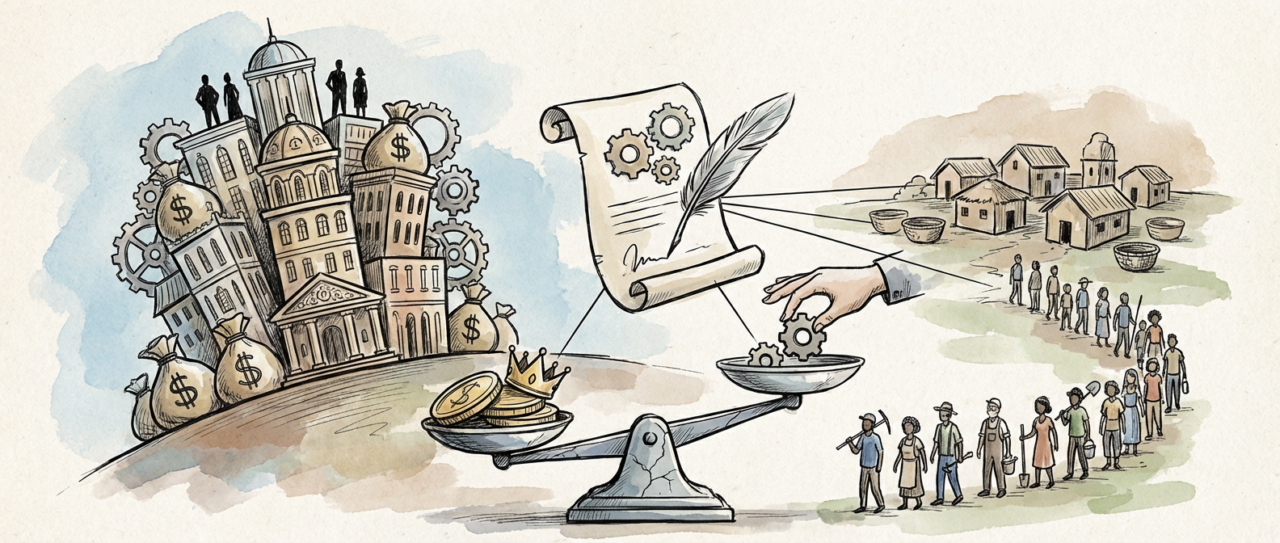
The Scale of Modern Wealth Concentration
Economic inequality has hit levels we haven’t seen since the Gilded Age, and it’s completely changing politics across developed nations. In most OECD countries, the richest one percent now controls more total wealth than the bottom sixty percent combined. That’s a massive shift from the relatively balanced distribution we saw after World War II through the 1970s.

This goes way beyond abstract statistics. When such a tiny slice of the population controls so much money, it ripples through everything: democratic institutions, job markets, your chances of moving up in life. Inequality.org data shows how this concentration got turbo-charged during the 2008 financial crisis and again during COVID, as asset prices soared while millions of workers watched their paychecks stagnate.
Political scientists are starting to see wealth concentration as a real threat to democracy itself. When economic power gets this concentrated, it inevitably becomes political power through campaign donations, lobbying spending, and the revolving door between private wealth and government jobs. You get this feedback loop where concentrated wealth shapes policy in ways that make the rich even richer.
Wealth Taxes Gain Political Momentum
Governments around the world are now seriously looking at wealth taxes as a direct way to tackle extreme concentration. France has tried various forms of wealth taxation over the past decade, though with mixed results and real concerns about rich people moving their money elsewhere. Spain recently brought in a temporary wealth tax that’s raised substantial revenue while sparking fierce debate about long-term economic competitiveness.
In the United States, several states are pushing wealth tax proposals even though there are constitutional questions about whether they can actually do this. California, New York, and Washington have all seen legislative proposals that would tax annual net worth above certain thresholds, typically starting at ten million dollars. These state-level efforts represent a real shift in American tax policy discussions, which have traditionally focused on income and sales taxes.
The technical challenges are huge. Wealth assessment requires sophisticated ways to value assets, especially hard-to-price stuff like private company shares, real estate, and complex financial instruments. Administrative costs can be enormous, and wealthy people have proven pretty good at restructuring assets or just moving somewhere else to avoid these taxes. Still, the political momentum suggests growing public appetite for directly tackling wealth concentration rather than just trying to redistribute income after the fact.
Universal Basic Income Pilots Expand Globally
Universal Basic Income programs represent a completely different approach that’s also gaining steam, though with different reasoning than wealth taxes. After successful pilot programs in Finland, Wales, and Kenya, multiple governments are expanding UBI experiments to test whether no-strings-attached cash payments can address inequality’s root causes while keeping people motivated to work and maintaining economic productivity.
The Finnish experiment gave monthly payments to unemployed people and found modest improvements in mental health and life satisfaction without people significantly reducing their job searches. Wales launched a more comprehensive pilot giving payments to young people aging out of care systems, testing whether early intervention can prevent long-term economic marginalization. Kenya’s program, which sends direct cash transfers to rural communities, has shown positive effects on local economic development and kids staying in school.
These pilots operate in very different economic contexts, but they share a common theory: direct cash transfers might be more efficient than complex welfare bureaucracies while giving people more autonomy. Critics worry that UBI could make people less willing to work and prove too expensive at scale, but supporters argue that automation and economic disruption require completely rethinking how societies distribute economic security.
Housing Costs Drive Intergenerational Wealth Gaps
Housing costs have hit levels relative to median incomes that we haven’t seen in forty years across English-speaking countries. This directly feeds wealth inequality by preventing younger generations from building equity through homeownership while simultaneously making existing property owners richer through rising home values.
The political impact is huge. In Australia, Canada, and the United Kingdom, housing costs have become central campaign issues, with younger voters increasingly backing parties that promise major housing policy reforms. Property ownership has become the main way wealth gets passed between generations, creating a split society between those whose families own property and those who don’t.
Policy responses vary wildly. Some places have implemented foreign buyer taxes or vacant property fees to reduce speculative demand. Others focus on zoning reform and building more housing. Brookings Institution research suggests that housing policy has become inseparable from broader inequality concerns, since property values now make up the biggest chunk of middle-class wealth in most developed economies.
Gig Economy Regulation Reshapes Labor Markets
The rise of platform-based work has created new types of economic inequality while messing with traditional job classifications. Across the European Union, United Kingdom, California, and Australia, governments are wrestling with how to regulate companies that call workers independent contractors while exercising serious control over their working conditions and pay.
California’s Assembly Bill 5 tried to reclassify many gig workers as employees, which triggered a massive corporate campaign that resulted in Proposition 22, creating a weird hybrid classification system. The European Union is developing continent-wide regulations for platform workers, while the UK has taken a sector-by-sector approach through employment tribunal decisions. Australia is considering similar reforms through its industrial relations system.
These regulatory battles reveal basic tensions between traditional employment protections and new economic models. Platform companies argue that flexibility benefits both workers and consumers, while labor advocates say that misclassification lets companies avoid providing health insurance, workers’ compensation, and other benefits that full-time employees get. How these policy debates turn out will significantly influence how economic gains from technological innovation get distributed across society.
Understanding these connected policy responses requires recognizing how wealth concentration, housing costs, job classification, and social safety nets interact to shape individual economic outcomes. As political systems worldwide wrestle with these challenges, the specific policy combinations they choose will determine whether current inequality trends continue or start to reverse. The stakes go beyond economics to the basic question of whether democratic societies can maintain legitimacy amid such dramatic wealth gaps.